HPLC for Insulin Analysis: A Comprehensive Guide to Method Development, Validation, and Optimization for Researchers
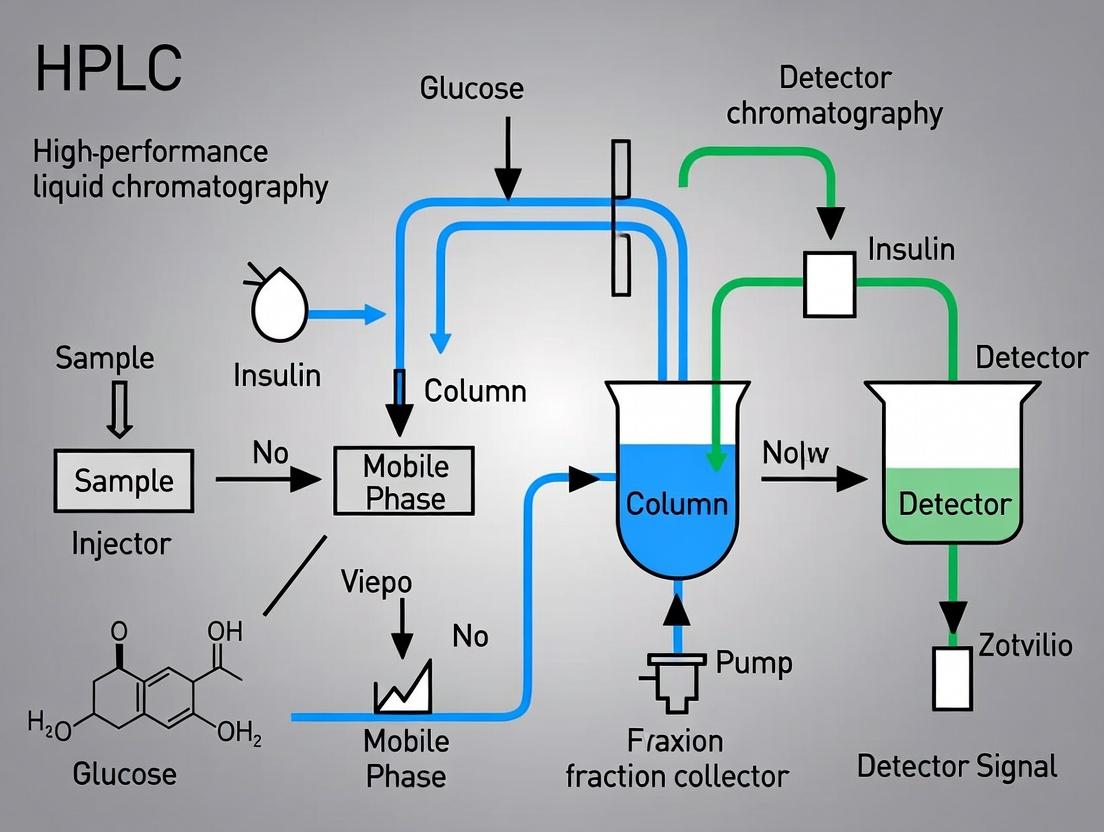
This article provides a detailed, current guide to high-performance liquid chromatography (HPLC) for the precise measurement of insulin concentration, tailored for researchers and pharmaceutical development professionals.
HPLC for Insulin Analysis: A Comprehensive Guide to Method Development, Validation, and Optimization for Researchers
Abstract
This article provides a detailed, current guide to high-performance liquid chromatography (HPLC) for the precise measurement of insulin concentration, tailored for researchers and pharmaceutical development professionals. It covers foundational principles of reversed-phase and size-exclusion HPLC as applied to insulin. The methodological section delivers step-by-step protocols for sample preparation, column selection, and mobile phase optimization. A dedicated troubleshooting segment addresses common challenges like peak tailing, recovery issues, and column degradation. Finally, the article examines validation strategies per ICH Q2(R2) guidelines and compares HPLC to other techniques like LC-MS and immunoassays, establishing its role in quality control and bioanalysis.
Understanding Insulin HPLC: Core Principles, Column Chemistry, and System Requirements
Within the broader context of research on High-performance liquid chromatography (HPLC) for insulin concentration measurement, this document delineates the technical rationale for HPLC's preeminence. While immunoassays (IA) like ELISA and RIA are prevalent in clinical settings, their limitations in specificity and standardization are well-documented. HPLC, particularly reversed-phase (RP) and size-exclusion (SEC) modes coupled with UV, fluorescence, or mass spectrometric (MS) detection, offers superior analytical performance for research and biopharmaceutical development.
Key Advantages of HPLC Over Immunoassays: A Quantitative Comparison
The following table summarizes the core advantages of HPLC, supported by quantitative performance data gathered from current literature.
Table 1: Comparative Analytical Performance of HPLC vs. Immunoassays for Insulin
| Parameter | Immunoassays (ELISA/RIA) | High-Performance Liquid Chromatography (RP/UHPLC-MS) |
|---|---|---|
| Specificity | High risk of cross-reactivity with insulin analogs, proinsulin, and C-peptide. | Exceptional specificity; can resolve insulin, its analogs, and degradation products. |
| Accuracy & Standardization | Variable between kits and laboratories; dependent on antibody lot. | Absolute quantification possible with pure insulin standards; highly reproducible. |
| Precision (CV) | Typically 5-15% inter-assay CV. | Typically <5% intra- and inter-assay CV. |
| Dynamic Range | ~2-3 orders of magnitude (non-linear). | ~3-4 orders of magnitude (linear). |
| Sample Throughput | High (parallel processing). | Moderate, but enhanced with UHPLC and automation. |
| Structural Insight | None; only immunoreactivity measured. | Direct; can identify and quantify specific molecular forms (e.g., deamidation, dimerization). |
| Sample Prep Complexity | Low to moderate (often dilute-and-shoot). | Moderate to high (requires extraction, sometimes SPE). |
| Cost per Sample | Lower reagent cost. | Higher instrumentation cost, but lower consumable cost per sample. |
Detailed Application Notes
Addressing Immunoassay Limitations
Immunoassays are plagued by variable antibody specificity, leading to overestimation of insulin concentration due to cross-reactivity with proinsulin (≈40-50% cross-reactivity in many assays) and insulin analogs. HPLC-MS provides definitive separation, distinguishing human insulin from lispro, aspart, glargine metabolites, and biosynthetic precursors with resolution (Rs) >2.0.
Critical for Biosimilar Development
Regulatory agencies (EMA, FDA) mandate orthogonal methods for critical quality attribute (CQA) assessment. HPLC is indispensable for quantifying product-related impurities (e.g., dimer <1.0%, desamido forms <2.0%) in biosimilar insulin drug substance and product release testing.
Experimental Protocols
Protocol 1: Reversed-Phase UHPLC-UV for Insulin Main Peak and Related Proteins
Objective: To separate and quantify insulin from its related substances (proinsulin, dimers) in a purified formulation.
Materials:
- Column: C18, 2.1 x 100 mm, 1.7 µm particle size, 300 Å pore size.
- Mobile Phase A: 0.1% Trifluoroacetic acid (TFA) in HPLC-grade water.
- Mobile Phase B: 0.1% TFA in acetonitrile (ACN).
- Standard Solutions: Insulin reference standard (USP) at 1 mg/mL in 0.01M HCl. Serial dilutions in diluent for calibration curve (0.01-1.0 mg/mL).
- System: UHPLC with diode array detector (DAD), detection at 214 nm.
Method:
- Sample Preparation: Dilute insulin sample in 0.01M HCl to a target concentration of ~0.5 mg/mL. Centrifuge at 14,000g for 10 min.
- Chromatographic Conditions:
- Flow Rate: 0.3 mL/min
- Column Temp: 40°C
- Injection Volume: 5 µL
- Gradient: 25% B to 40% B over 15 min (linear).
- Quantification: Integrate peak areas. Plot calibration curve (area vs. concentration). Calculate sample concentration using linear regression (typical R² >0.999).
Protocol 2: SPE Extraction and LC-MS/MS for Insulin in Biological Matrices
Objective: To quantify endogenous insulin in plasma with high specificity.
Materials:
- SPE Cartridges: Mixed-mode cation-exchange (MCX) 96-well plates.
- Internal Standard: Stable isotope-labeled insulin (e.g., [13C6]-Insulin).
- LC-MS/MS System: Triple quadrupole mass spectrometer with electrospray ionization (ESI) source.
Method:
- Sample Prep: Add 50 µL of plasma to 100 µL of internal standard working solution in 1% formic acid. Vortex.
- SPE: Condition MCX plate with methanol, then water. Load samples. Wash with 2% formic acid in water, then methanol. Elute with 5% NH4OH in 80:20 MeOH:Water. Evaporate eluent and reconstitute in 0.1% formic acid.
- LC Conditions: Use a shallow gradient on a C8 column (50 x 2.1 mm, 2.6 µm) with 0.1% formic acid in water and ACN.
- MS Detection: ESI+ mode, Multiple Reaction Monitoring (MRM). For human insulin: Q1 580.8 → Q3 136.2 (quantifier) and 580.8 → 226.2 (qualifier). Use internal standard peak area for ratio-based quantification.
Visualization of Workflows and Relationships
Diagram Title: Analytical Paths: Immunoassay vs. HPLC for Insulin
Diagram Title: LC-MS/MS Workflow for Plasma Insulin
The Scientist's Toolkit: Key Research Reagent Solutions
Table 2: Essential Materials for Insulin HPLC Analysis
| Item | Function & Rationale |
|---|---|
| Insulin Reference Standard (USP/Ph. Eur.) | Provides primary calibrant for absolute quantification, ensuring accuracy and traceability. |
| Stable Isotope-Labeled Internal Standard (e.g., [13C6]-Insulin) | Compensates for sample preparation and ionization variability in LC-MS, critical for precision in complex matrices. |
| Mass Spectrometry-Grade Solvents (ACN, MeOH, Water) | Minimize chemical noise and ion suppression in LC-MS, ensuring optimal detector sensitivity. |
| TFA or Formic Acid (LC-MS Grade) | Acts as ion-pairing agent (TFA for RP-UV) or volatile pH modifier (Formic Acid for MS) for optimal separation and ionization. |
| Solid-Phase Extraction (SPE) Plates (Mixed-Mode MCX) | Selective extraction and cleanup of insulin from biological fluids, removing salts and phospholipids that interfere with analysis. |
| UHPLC Columns (C18 or C8, 300Å, sub-2µm) | Provides high-resolution separation of insulin monomers from aggregates and degradation products. Large pore size accommodates the protein. |
Within the broader thesis on High-Performance Liquid Chromatography (HPLC) for insulin concentration measurement and characterization research, the selection of chromatographic mode is paramount. Insulin, a 5.8 kDa peptide hormone critical for diabetes therapy, presents analytical challenges due to its propensity to form oligomers (dimers, hexamers) and degradation products (deamidated, hydrolyzed, high-molecular-weight aggregates). This document details two primary, orthogonal HPLC modes—Reversed-Phase (RP-HPLC) and Size-Exclusion (SEC-HPLC)—providing application notes and standardized protocols for their use in insulin research and quality control within drug development.
Core Principles & Application Notes
Reversed-Phase HPLC (RP-HPLC)
- Principle: Separation based on hydrophobicity. Insulin interacts with a non-polar stationary phase (e.g., C4, C8, C18 bonded silica) and is eluted with a gradient of increasing organic solvent (acetonitrile) in an aqueous, often ion-pairing, mobile phase.
- Primary Applications:
- Purity Analysis & Related Substances: High-resolution separation of insulin from its deamidated forms (AspA21, IsoAspB3), insulin precursors, and other hydrophobic variants.
- Potency Assay: Quantification of intact monomeric insulin.
- Stability Studies: Monitoring formation of degradation products under stress conditions (heat, pH).
Size-Exclusion HPLC (SEC-HPLC)
- Principle: Separation based on hydrodynamic volume (size). Molecules are separated as they permeate through porous beads; larger molecules (aggregates) elute first, while smaller molecules (monomer, fragments) elute later.
- Primary Applications:
- Aggregation Analysis: Quantification of high-molecular-weight proteins (HMWP), dimers, and hexamers.
- Oligomeric State Profiling: Assessing the formulation-dependent state of insulin (monomer vs. hexamer).
- Stability Studies: Monitoring aggregate formation over time.
Table 1: Comparison of RP-HPLC and SEC-HPLC for Insulin Analysis
| Parameter | Reversed-Phase (RP-HPLC) | Size-Exclusion (SEC-HPLC) |
|---|---|---|
| Separation Mechanism | Hydrophobicity | Hydrodynamic size (Stokes radius) |
| Stationary Phase | Alkyl-bonded silica (C4, C8, C18) | Porous silica or polymer beads (e.g., silica-based, polyhydroxyethyl A) |
| Mobile Phase | Gradient: Water/Acetonitrile with ion-pairing agent (e.g., TFA) | Isocratic: Aqueous buffer with controlled ionic strength (e.g., phosphate + NaCl) |
| Key Resolved Species | Insulin monomer, deamidated forms, insulin precursors | HMW aggregates, insulin hexamer/dimer, monomer, fragments |
| Typical Run Time | 20-40 minutes | 15-30 minutes |
| Detection | UV at 214 nm (peptide bond) or 280 nm | UV at 214 nm or 280 nm |
| Strength | High resolution for covalent modifications | Native-state analysis of quaternary structure |
| Limitation | Uses denaturing conditions; cannot resolve aggregates from monomer under native conditions | Lower resolution; limited ability to separate similar-sized species |
Detailed Experimental Protocols
Protocol 4.1: RP-HPLC for Insulin Purity and Related Substances
Objective: To separate and quantify human insulin from its major related substances (A21-desamido, B3-desamido, insulin precursors).
Materials: See "The Scientist's Toolkit" (Section 6).
Methodology:
- Sample Preparation: Dilute insulin sample in 0.01M HCl to a concentration of approximately 1 mg/mL. Filter through a 0.22 μm PVDF syringe filter.
- Mobile Phase Preparation:
- Mobile Phase A: 0.1% Trifluoroacetic acid (TFA) in HPLC-grade water.
- Mobile Phase B: 0.08% TFA in HPLC-grade acetonitrile.
- Chromatographic Conditions:
- Column: C18, 250 mm x 4.6 mm, 5 μm particle size, 300 Å pore size.
- Temperature: 40°C
- Flow Rate: 1.0 mL/min
- Detection: UV at 214 nm
- Injection Volume: 20 μL
- Gradient Program:
Time (min) %A %B 0 75 25 30 50 50 31 10 90 36 10 90 37 75 25 45 75 25
- Data Analysis: Identify peaks by comparison with reference standards. Calculate percentage of related substances by peak area normalization.
Protocol 4.2: SEC-HPLC for Insulin Aggregate Analysis
Objective: To quantify high-molecular-weight aggregates (HMWP) and the monomeric content of an insulin formulation.
Materials: See "The Scientist's Toolkit" (Section 6).
Methodology:
- Sample Preparation: Dilute insulin formulation with the SEC mobile phase to a concentration of 1 mg/mL. Do not filter unless necessary (risk of losing aggregates); centrifuge at 10,000g for 5 minutes if cloudy.
- Mobile Phase Preparation: 20 mM Sodium Phosphate, 200 mM NaCl, pH 7.4. Filter through a 0.22 μm membrane and degass.
- Chromatographic Conditions:
- Column: Silica-based SEC column, 300 mm x 7.8 mm, 5 μm particle size, 250 Å pore size.
- Temperature: 25°C
- Flow Rate: 1.0 mL/min
- Detection: UV at 214 nm
- Injection Volume: 20 μL
- Elution: Isocratic for 30 minutes.
- Data Analysis: Integrate peaks for aggregates (eluting first), monomer, and any fragments. Quantify %HMWP using the formula: (Area of aggregate peaks / Total area of all peaks) x 100%. Calibrate column with protein standards (e.g., thyroglobulin, insulin, aprotinin) for molecular weight estimation.
Visualizations
Diagram 1: Workflow for Insulin Analysis by HPLC Mode
Diagram 2: RP-HPLC vs. SEC Separation Mechanism
The Scientist's Toolkit: Essential Research Reagent Solutions
Table 2: Key Materials for Insulin HPLC Analysis
| Item & Typical Product Name/Type | Function in Analysis |
|---|---|
| C18 RP-HPLC Column (e.g., 250 x 4.6 mm, 300Å, 5µm) | Provides the hydrophobic surface for high-resolution separation of insulin variants based on slight differences in hydrophobicity. The wide pore (300Å) is suitable for peptides/proteins. |
| SEC-HPLC Column (e.g., silica-based, 300 x 7.8 mm, 250Å, 5µm) | Provides porous network for size-based separation. Critical for resolving aggregates from monomeric insulin under non-denaturing conditions. |
| Trifluoroacetic Acid (TFA), HPLC Grade | Acts as an ion-pairing agent in RP-HPLC mobile phases, improving peak shape and resolution of insulin and its related substances. |
| Acetonitrile (ACN), HPLC Gradient Grade | Organic modifier in RP-HPLC. The gradient increase in ACN concentration elutes insulin species based on their hydrophobicity. |
| Phosphate Buffer Salts & Sodium Chloride (HPLC Grade) | Used to prepare the aqueous, isotonic mobile phase for SEC-HPLC, maintaining insulin in its native state and controlling column interactions. |
| Insulin Reference Standards (e.g., WHO International Standard, USP Insulin Human) | Essential for peak identification, system suitability testing, and quantitative calibration in both RP and SEC methods. |
| Protein Molecular Weight Markers Kit (for SEC calibration) | Used to calibrate the SEC column to estimate the molecular size of insulin aggregates and confirm the elution position of the monomer. |
| 0.22 µm PVDF Syringe Filters | For filtering mobile phases and RP-HPLC samples to remove particulates that could damage the HPLC column. (Use with caution for SEC aggregate analysis). |
Application Notes for HPLC Analysis of Insulin
Accurate measurement of insulin concentration is critical in pharmacokinetic studies, formulation development, and quality control for diabetes therapeutics. The core HPLC instrumentation—comprising precise pumps, temperature-controlled autosamplers, and sensitive detectors—directly impacts the accuracy, precision, and robustness of these analyses. Optimal configuration minimizes adsorption losses, maintains molecular integrity, and enables detection at low concentrations.
Key Performance Data for Insulin HPLC Analysis:
Table 1: Representative Chromatographic Conditions for Insulin Quantification
| Parameter | Setting/Value | Rationale |
|---|---|---|
| Column | C18, 300Å, 3.5 µm, 2.1 x 150 mm | Large pore size accommodates insulin's ~5.8 kDa size; sub-2µm or 3.5µm particles offer efficiency. |
| Mobile Phase A | 0.1% TFA in Water | Trifluoroacetic acid (TFA) acts as an ion-pairing agent, improving peak shape for polypeptides. |
| Mobile Phase B | 0.1% TFA in Acetonitrile | Organic modifier for gradient elution. Acetonitrile offers low UV cutoff and viscosity. |
| Gradient | 25% B to 40% B over 10-15 min | Isocratic or shallow gradients resolve insulin from its degradation products (desamido, dimers). |
| Flow Rate | 0.2 - 0.5 mL/min | Standard for narrow-bore columns, optimizing sensitivity and solvent consumption. |
| Column Temp. | 40 - 60°C | Increases efficiency, reduces backpressure, and can improve peak shape. |
| Injection Vol. | 5 - 20 µL | Balances sensitivity with potential column overload. |
| Detection | UV @ 214 nm | Peptide bond absorbance; optimal sensitivity for proteins/peptides. |
Table 2: Detector Comparison for Insulin Analysis
| Detector Type | Typical LOQ for Insulin | Key Advantage | Primary Limitation |
|---|---|---|---|
| UV (Fixed Wavelength) | ~1-5 ng on-column | Robustness, simplicity, wide linear dynamic range. | Limited selectivity, cannot confirm peak purity. |
| Photodiode Array (PDA) | ~1-5 ng on-column | Spectral confirmation, peak purity assessment. | Slightly less sensitive than fixed UV; more complex. |
| Fluorescence (FLD) | ~0.1-0.5 ng on-column | Exceptional sensitivity and selectivity for labeled insulin. | Requires derivatization (e.g., with OPA, fluorescamine). |
Experimental Protocols
Protocol 1: Standard Preparation and System Suitability for Insulin Quantification
Objective: To prepare calibration standards and evaluate HPLC system performance prior to sample analysis.
Materials:
- Recombinant human insulin reference standard.
- Diluent: 0.01N HCl or mobile phase A.
- HPLC vials with low-adsorption inserts.
Procedure:
- Primary Stock Solution (1 mg/mL): Accurately weigh ~10 mg of insulin reference standard into a 10 mL volumetric flask. Dissolve and dilute to volume with diluent. Aliquot and store at ≤ -60°C.
- Working Standard Series: Prepare a serial dilution from the primary stock to create at least six calibration levels covering the expected sample concentration range (e.g., 1–100 µg/mL). Use polypropylene tubes for dilutions.
- System Suitability Test (SST): Inject a mid-level standard (e.g., 50 µg/mL) in replicates (n=5).
- Acceptance Criteria: Calculate and verify the following meet laboratory specifications:
- Retention Time RSD: ≤ 1.0%
- Peak Area RSD: ≤ 2.0%
- Theoretical Plates (N): > 10,000
- Tailing Factor (T): ≤ 2.0
- Resolution (Rs): From closest eluting known impurity (if available), Rs ≥ 2.0.
Protocol 2: Quantitative HPLC-UV Analysis of Insulin in Formulation
Objective: To determine the concentration of insulin in a pharmaceutical formulation (e.g., injection vial).
Materials:
- Test formulation.
- Appropriate dissolution solvent (e.g., 0.01N HCl).
- 0.22 µm PVDF syringe filter.
Procedure:
- Sample Preparation: Transfer the contents of the formulation vial quantitatively into a suitable volumetric flask. Rinse the vial several times with dissolution solvent and combine rinses. Dilute to mark and mix gently to avoid foaming.
- Further Dilution: Dilute an aliquot of the above solution with mobile phase A to bring the expected insulin concentration within the calibration range.
- Filtration: Pass the final sample solution through a 0.22 µm PVDF filter into an HPLC vial.
- Chromatographic Analysis:
- Equilibrate the C18 column with initial mobile phase conditions (e.g., 25% B) for at least 10 column volumes.
- Set the UV detector to 214 nm.
- Maintain the autosampler temperature at 4-10°C.
- Program the autosampler to inject 10 µL of the filtered sample.
- Run the gradient method as specified in Table 1.
- Quantification: Integrate the insulin peak. Use the external standard calibration curve (peak area vs. concentration) to calculate the insulin concentration in the original formulation.
Protocol 3: Peak Purity Assessment of Insulin via HPLC-PDA
Objective: To confirm the homogeneity of the insulin peak and detect co-eluting impurities.
Procedure:
- Perform the chromatographic separation as in Protocol 2 using a PDA detector.
- Set the PDA to acquire spectra from 200–350 nm during the entire run.
- After acquisition, analyze the insulin peak:
- Spectral Overlay: Extract spectra from the upslope, apex, and downslope of the insulin peak. Overlay them.
- Purity Factor/Match: Use the instrument software to calculate a purity factor (or spectral match) by comparing these spectra against a reference spectrum of pure insulin.
- Interpretation: A high purity match (> 990) indicates a spectrally homogeneous peak. Significant spectral differences across the peak suggest a co-eluting impurity.
Protocol 4: Sensitive Determination of Insulin via Pre-column Derivatization and HPLC-FLD
Objective: To achieve ultra-sensitive quantification of insulin in biological matrices (e.g., plasma).
Materials:
- Fluorescamine solution (0.3 mg/mL in acetone).
- Borate buffer (0.2M, pH 9.0).
- Solid-phase extraction (SPE) cartridges (C18).
Procedure:
- Sample Extraction: Precipitate proteins from plasma using acetonitrile. Isolate insulin via SPE (condition, load, wash, elute). Evaporate the eluent and reconstitute in 50 µL of borate buffer.
- Derivatization: Add 50 µL of fluorescamine solution to the reconstituted sample. Vortex immediately for 30 seconds.
- Reaction Quench: After 1 minute, add 100 µL of 0.1M HCl to stop the reaction.
- Chromatography: Inject 20 µL onto the HPLC-FLD system within 30 minutes.
- FLD Settings: Excitation = 390 nm, Emission = 475 nm.
- Use a rapid gradient to separate derivatized insulin from reagent byproducts.
- Quantification: Prepare and derivatize calibration standards in parallel. Plot peak area vs. concentration for quantification.
Visualizations
HPLC Workflow for Insulin Analysis
Insulin Analysis Pathways & Detection Options
The Scientist's Toolkit: Research Reagent Solutions
Table 3: Essential Materials for Insulin HPLC Research
| Item | Function & Rationale |
|---|---|
| Recombinant Insulin Reference Standard | Certified primary standard for accurate calibration and identification. |
| LC-MS Grade Water & Acetonitrile | Ultra-pure solvents minimize baseline noise and ghost peaks in sensitive detection. |
| Sequencing Grade TFA (Trifluoroacetic Acid) | High-purity ion-pairing reagent for optimal peptide peak shape and resolution. |
| Polypropylene Vials/Tubes | Minimizes adsorptive loss of insulin to container walls compared to glass or polystyrene. |
| Low-Protein-Binding Filters (PVDF, 0.22 µm) | Removes particulates without significantly adsorbing the analyte of interest. |
| Wide-Pore C18 HPLC Column (300Å, 3.5µm) | Stationary phase designed for efficient separation of large biomolecules like insulin. |
| Fluorescamine Derivatization Kit | Enables highly sensitive fluorescence detection for trace analysis in complex matrices. |
| Borate Buffer (pH 9.0) | Provides optimal alkaline conditions for efficient pre-column fluorescamine reaction. |
| SPE Cartridges (C18 or Mixed-Mode) | For selective extraction and concentration of insulin from biological samples (plasma). |
Insulin's Chemical Structure and Its Implications for Chromatographic Behavior
Insulin is a peptide hormone critical for glucose regulation. Its chemical structure—comprising two polypeptide chains (A and B) linked by disulfide bonds—directly influences its analytical characterization. Within the broader thesis on High-Performance Liquid Chromatography (HPLC) for insulin concentration measurement, understanding this relationship is paramount for developing robust, precise, and accurate quantitative methods essential for pharmaceutical development and quality control.
Key Structural Features of Insulin Affecting HPLC
Insulin's chromatographic behavior is dictated by its specific physicochemical properties.
Primary Structure and Hydrophobicity
Human insulin is a 51-amino acid protein (A-chain: 21 residues; B-chain: 30 residues). The distribution of hydrophobic (e.g., Phe, Val, Leu) and hydrophilic residues creates a distinct hydrophobic "footprint." This determines retention on reversed-phase (RP) columns.
Disulfide Bonding and Tertiary Structure
Three disulfide bonds (two interchain, one intrachain in the A-chain) constrain the molecule. Under native, non-denaturing conditions, this compact structure may shield hydrophobic regions. Denaturing conditions (e.g., low pH, organic modifiers) can unfold the protein, altering retention time.
Isoelectric Point (pI) and Charge
The calculated pI of human insulin is approximately 5.3. At a pH below the pI, insulin carries a net positive charge; above the pI, a net negative charge. This is critical for ion-exchange (IEX) and hydrophobic interaction chromatography (HIC).
Molecular Weight and Oligomerization
The monomeric molecular weight is ~5808 Da. In solution near neutral pH, insulin self-associates into dimers, hexamers (with zinc), and higher-order aggregates. Chromatographic conditions must be designed to separate and quantify these forms.
Table 1: Quantitative Physicochemical Properties of Human Insulin
| Property | Value | Chromatographic Implication |
|---|---|---|
| Molecular Weight (Monomer) | 5807.57 Da | Size-exclusion chromatography (SEC) calibration |
| Isoelectric Point (pI) | ~5.3 | Choice of pH for IEX and RP-HPLC |
| Number of Disulfide Bonds | 3 | Stability; requires reducing conditions for peptide mapping |
| Extinction Coefficient (ε280) | ~1.0 (for 1 mg/mL, 1 cm path) | Quantification via UV detection |
| Common Oligomeric States | Monomer, Dimer, Hexamer, Aggregate | SEC and RP-HPLC method must resolve species |
Detailed HPLC Application Notes and Protocols
Protocol A: Reversed-Phase HPLC (RP-HPLC) for Insulin Purity and Stability
Objective: Separate insulin from its degradation products (deamidated, hydrolyzed, dimeric forms) and excipients.
Materials & Reagents:
- Column: C18 (e.g., 4.6 x 250 mm, 300 Å pore size, 5 μm particle).
- Mobile Phase A: 0.1% Trifluoroacetic acid (TFA) in HPLC-grade water.
- Mobile Phase B: 0.1% TFA in Acetonitrile (ACN).
- Insulin Standard Solution: 1.0 mg/mL in 0.01 M HCl.
- System: HPLC with UV detector capable of 214 nm.
Detailed Procedure:
- Column Equilibration: Equilibrate column with 25% B for at least 30 min at 1.0 mL/min.
- Gradient Elution:
- 0-5 min: 25% B (hold)
- 5-40 min: 25% → 40% B (linear gradient)
- 40-41 min: 40% → 90% B
- 41-46 min: 90% B (wash)
- 46-47 min: 90% → 25% B
- 47-60 min: 25% B (re-equilibration)
- Injection: Inject 20 μL of standard or sample. Column temperature: 40°C. Detection: 214 nm.
- Analysis: Identify main insulin peak by retention time of standard. Quantify using peak area against a 5-point calibration curve (e.g., 0.05-2.0 mg/mL).
Expected Outcome: Insulin elutes typically between 20-30 minutes. Deamidated forms (more hydrophilic) elute earlier; covalent dimers and aggregates elute later.
Protocol B: Size-Exclusion HPLC (SEC-HPLC) for Insulin Aggregate Analysis
Objective: Quantify high molecular weight (HMW) aggregates and fragments.
Materials & Reagents:
- Column: SEC column (e.g., 7.8 x 300 mm, 100-300 Å pore size).
- Mobile Phase: 0.1 M Sodium phosphate, 0.1 M Sodium sulfate, pH 7.2. Filter (0.22 μm) and degas.
- Molecular Weight Standards: Protein standards in the 1-100 kDa range.
Detailed Procedure:
- Isocratic Elution: Set mobile phase flow to 0.8 mL/min. Equilibrate for ≥60 min.
- Standard Run: Inject standards individually to generate a calibration curve (log(MW) vs. retention time).
- Sample Run: Inject 50 μL of insulin sample (1 mg/mL in mobile phase). Detection: 214 nm.
- Analysis: Integrate peaks. HMW aggregates appear first (shorter retention time), followed by insulin hexamer/dimer/monomer, then fragments.
Table 2: SEC-HPLC Calibration and Sample Results
| Component | Retention Time (min) | Approx. Molecular Weight | % of Total Peak Area (Example) |
|---|---|---|---|
| Aggregate (>Hexamer) | 12.5 | >36 kDa | 0.8% |
| Insulin Hexamer | 13.8 | 36 kDa | 4.5% |
| Insulin Dimer | 15.2 | 11.6 kDa | 94.0% |
| Insulin Monomer | 16.0 | 5.8 kDa | 0.5% |
| Fragment | 17.5 | <5 kDa | 0.2% |
The Scientist's Toolkit: Research Reagent Solutions
Table 3: Essential Materials for Insulin HPLC Analysis
| Item | Function & Rationale |
|---|---|
| C18 RP-HPLC Column (300 Å) | Wide pores allow large peptide/protein access to stationary phase, improving resolution and peak shape. |
| Trifluoroacetic Acid (TFA) | Ion-pairing reagent in RP-HPLC. Suppresses silanol activity and improves separation by interacting with basic amino acids. |
| Acetonitrile (HPLC Grade) | Organic modifier for RP-HPLC. Provides strong eluting power and low UV absorbance. |
| Phosphate/Sulfate SEC Buffer | Maintains ionic strength to minimize non-size exclusion interactions between insulin and column matrix. |
| Zinc Chloride | Used in sample prep to stabilize the insulin hexamer, allowing study of specific oligomeric forms in SEC. |
| Dithiothreitol (DTT) | Reducing agent. Breaks disulfide bonds for peptide mapping or analysis of reduced insulin chains. |
| 0.01 M Hydrochloric Acid | Common insulin solubilization/storage solvent. Prevents aggregation and deamidation at low pH. |
Visualization of Experimental Workflows
Diagram Title: RP-HPLC Protocol for Insulin Analysis
Diagram Title: How Insulin Structure Dictates HPLC Behavior
This application note details the integration of regulatory standards from the United States Pharmacopeia (USP) and the International Council for Harmonisation (ICH) into analytical protocols for the quantification of insulin and related peptides via High-Performance Liquid Chromatography (HPLC). The methodologies are framed within a thesis research context focusing on precise insulin concentration measurement for stability and potency assessment.
USP monographs provide legally enforceable standards for drug substances and products, while ICH guidelines offer internationally harmonized recommendations for analytical method development and validation.
Table 1: Key Regulatory Documents for Insulin Peptide Analysis
| Regulatory Body | Document/Chapter | Title/Scope | Primary Relevance to Insulin HPLC Analysis |
|---|---|---|---|
| USP | Monograph <121> |
Insulin Human | Defines identity, assay (HPLC), and purity tests (related proteins by HPLC) for human insulin. |
| USP | Monograph <1251> |
Weighing on an Analytical Balance | Foundational guidance for accurate sample preparation. |
| USP | General Chapter <621> |
Chromatography | Specifies system suitability parameters (e.g., plate count, tailing factor) for HPLC methods. |
| USP | General Chapter <1225> |
Validation of Compendial Procedures | Aligns with ICH Q2(R1) for method validation. |
| ICH | Guideline Q2(R1) | Validation of Analytical Procedures | Defines validation characteristics: specificity, accuracy, precision, LOD, LOQ, linearity, range. |
| ICH | Guideline Q3B(R2) | Impurities in New Drug Products | Guides setting specifications for degradation products (e.g., A21 desamido insulin). |
| ICH | Guideline Q6B | Specifications: Test Procedures and Acceptance Criteria for Biotechnological/Biological Products | Informs setting acceptance criteria for identity, assay, and purity. |
Table 2: Typical System Suitability Criteria from USP <621> for Insulin RP-HPLC
| Parameter | Acceptance Criterion | Purpose |
|---|---|---|
| Relative Standard Deviation (RSD) for Peak Area (n=5) | ≤ 2.0% | Ensures precision of injection. |
| Theoretical Plates (N) | ≥ 2000 | Ensures column efficiency. |
| Tailing Factor (T) | ≤ 2.0 | Ensures peak symmetry. |
| Resolution (Rs) from closest eluting known impurity | ≥ 2.0 | Ensures separation from degradants. |
Experimental Protocols
Protocol 1: HPLC Method for Insulin Assay and Related Proteins (Based on USP)
- Objective: To quantify insulin content and determine the relative amounts of related proteins (e.g., desamido, dimeric forms).
- Principle: Reversed-Phase (RP) HPLC with UV detection.
- Materials & Reagents: See The Scientist's Toolkit below.
- Procedure:
- Mobile Phase Preparation: Prepare aqueous (MP-A) and organic (MP-B) phases as specified. For example: MP-A: 0.2M Sodium Sulfate, adjusted to pH 2.3 with Phosphoric Acid. MP-B: Acetonitrile.
- Standard Solution: Accurately weigh USP Insulin Human RS. Dissolve in 0.01N HCl to a known concentration (e.g., 1 mg/mL).
- Sample Solution: Prepare the test sample in identical diluent to match standard concentration.
- Chromatographic Conditions:
- Column: Octadecylsilyl (C18), 4.6 x 250 mm, 5 µm.
- Temperature: 40°C.
- Detection: 214 nm.
- Gradient: Program from approximately 30% MP-B to 50% MP-B over 30-40 minutes.
- Flow Rate: 1.0 mL/min.
- Injection Volume: 20 µL.
- System Suitability Test: Perform five replicate injections of the standard solution. Calculate and verify parameters per Table 2.
- Analysis: Inject standard and sample solutions in duplicate. Calculate insulin content using external standard calibration. Integrate all peaks and report percent of related proteins.
Protocol 2: Method Validation for Specificity and Accuracy (Based on ICH Q2(R1))
- Objective: To validate that the HPLC method specifically quantifies insulin in the presence of degradants/excipients and to determine its accuracy.
- Procedure for Specificity (Forced Degradation):
- Stress Samples: Subject insulin solution to acid/base hydrolysis, oxidation, thermal, and photolytic stress to generate degradants (e.g., A21 desamido, high molecular weight proteins).
- Analysis: Inject stressed samples and placebo (excipients only). Assess chromatograms for peak purity (e.g., via PDA detector) and resolution between insulin main peak and degradation peaks.
- Procedure for Accuracy (Recovery):
- Spiked Samples: Prepare a placebo matrix at three concentration levels (e.g., 80%, 100%, 120% of target). Spike with known amounts of insulin reference standard.
- Analysis: Analyze each level in triplicate. Calculate recovery (%) = (Measured Concentration / Added Concentration) * 100.
- Acceptance: Mean recovery should be within 98.0–102.0% with RSD < 2.0%.
Visualizations
(Diagram 1: HPLC Method Lifecycle for Insulin Analysis)
(Diagram 2: Specificity Study via Forced Degradation Pathway)
The Scientist's Toolkit: Research Reagent Solutions
Table 3: Essential Materials for Insulin HPLC Analysis
| Item | Function/Benefit | Example/Note |
|---|---|---|
| USP Insulin Human Reference Standard | Primary calibrant for quantitative assay; ensures traceability to compendial standard. | Must be stored as per certificate. |
| High-Purity Water (HPLC Grade) | Solvent for mobile phase and sample prep; minimizes baseline noise and ghost peaks. | Resistivity ≥ 18 MΩ·cm. |
| HPLC-Grade Acetonitrile & TFA | Organic modifier and ion-pairing agent in RP-HPLC; critical for peptide separation and peak shape. | Low UV absorbance. |
| C18 RP-HPLC Column | Stationary phase for separating insulin from its related substances based on hydrophobicity. | 250-300 mm length, 5 µm particle size. |
| pH Meter & Buffers | Accurate preparation of mobile phase to specified pH; critical for reproducibility. | Regular calibration required. |
| Analytical Balance | Precise weighing of reference standard and samples per USP <1251>. |
Calibrated, sensitivity to 0.01 mg. |
| PDA or UV Detector | Detection of insulin at low UV wavelength (214 nm for peptide bond). | PDA allows peak purity assessment. |
| Data Acquisition Software | System control, data collection, and integration of peak areas for calculation. | Must be compliant with 21 CFR Part 11 if for GMP use. |
Step-by-Step HPLC Method Development for Insulin: From Sample Prep to Data Analysis
Optimal Sample Preparation Techniques for Formulations and Biological Matrices
Introduction Within the thesis "Advancements in High-Performance Liquid Chromatography for the Quantification of Insulin and Its Analogs in Pharmaceutical Development and Pharmacokinetic Studies," optimal sample preparation is established as the critical determinant of analytical success. This document provides detailed application notes and protocols for preparing both formulation (drug product) and complex biological matrices (e.g., plasma, serum) prior to HPLC analysis, focusing on specificity, recovery, and reproducibility.
1. Application Notes: Core Principles & Data Summary
1.1 Key Challenges by Matrix Type
- Formulations: Excipients (e.g., zinc, phenol, cresol, polysorbates) can interfere with chromatography, cause column adsorption, or mask the insulin peak.
- Biological Matrices: High-abundance proteins (e.g., albumin), phospholipids, and endogenous compounds cause matrix effects, ion suppression/enhancement in LC-MS, and column fouiling. Insulin's low endogenous concentration (pmol/L to nmol/L) and susceptibility to enzymatic degradation (proteases) and adsorption to surfaces are major hurdles.
1.2 Quantitative Comparison of Common Sample Preparation Techniques The selection of a technique involves trade-offs between recovery, cleanliness, and throughput. The following table summarizes performance metrics for key methods.
Table 1: Comparison of Sample Preparation Techniques for Insulin HPLC Analysis
| Technique | Principle | Typical Recovery for Insulin | Key Advantage | Key Limitation | Best Suited For |
|---|---|---|---|---|---|
| Protein Precipitation (PPT) | Organic solvents denature and precipitate proteins. | 70-85% | Fast, simple, low cost. | Poor selectivity, high matrix effect. | Formulations; crude biological extract for screening. |
| Solid-Phase Extraction (SPE) | Selective adsorption/desorption from a sorbent. | 80-95% | Excellent cleanup, concentration, reduced matrix effect. | Method development time, cost per sample. | Plasma/Serum for specific HPLC-UV/FLD assays. |
| Liquid-Liquid Extraction (LLE) | Partitioning between immiscible solvents. | 75-90% | Effective removal of salts and polar interferences. | Emulsion formation, large solvent volumes. | Matrices with high lipid content. |
| Immunoaffinity Extraction (IAE) | Antibody-mediated capture of insulin. | >95% | Exceptional specificity and cleanup. | Very high cost, antibody lot variability. | Ultra-selective pre-concentration for complex matrices (LC-MS). |
| Solid-Phase Microextraction (SPME) | Adsorption onto a coated fiber, then desorption. | 60-80% | Minimal solvent, automation-friendly. | Lower recovery, fiber cost and fragility. | Research applications for small sample volumes. |
2. Detailed Experimental Protocols
2.1 Protocol A: SPE for Human Insulin from Plasma (Reverse-Phase C18)
- Objective: Isolate and concentrate insulin from plasma prior to RP-HPLC-UV analysis.
- Materials: C18 SPE cartridges (e.g., 50 mg/3 mL), vacuum manifold, centrifuges, solvents (HPLC-grade ACN, MeOH, Water), 1% Trifluoroacetic acid (TFA) in water, 0.1% TFA in 70% ACN/water.
- Procedure:
- Conditioning: Sequentially pass 3 mL MeOH, then 3 mL 1% aqueous TFA through the cartridge at ~1 mL/min. Do not let the sorbent dry.
- Loading: Acidify 500 µL of plasma with 500 µL of 1% TFA. Mix, centrifuge (10,000 × g, 5 min). Load the clear supernatant onto the cartridge at ~0.5 mL/min.
- Washing: Wash with 3 mL of 5% MeOH in 1% aqueous TFA to remove weakly retained interferences.
- Elution: Elute insulin into a clean polypropylene tube with 2 × 1 mL of 0.1% TFA in 70% ACN/water. Evaporate the eluent under a gentle stream of nitrogen at 37°C.
- Reconstitution: Reconstitute the dried residue in 100 µL of HPLC mobile phase A (e.g., 0.1% TFA in water). Vortex thoroughly, centrifuge, and transfer to HPLC vials.
2.2 Protocol B: Simple Dilution & Digestion for Insulin Formulation Analysis
- Objective: Prepare a simple insulin drug product (solution) for stability-indicating RP-HPLC.
- Materials: HPLC-grade water, 0.01M HCl, phosphate buffer (pH 7.4).
- Procedure:
- Dilution: Accurately dilute the formulation with a compatible solvent (e.g., 0.01M HCl or pH 7.4 phosphate buffer) to a target concentration within the HPLC calibration range (typically 0.1-1 mg/mL).
- Excipient Digestion (if needed): For zinc-suspended formulations, add an equal volume of 0.1M EDTA solution (in dilution buffer) to dissociate the hexamer and release insulin monomer. Allow to incubate for 15-30 minutes at room temperature.
- Clarification: Centrifuge the diluted sample at 14,000 × g for 10 minutes to pellet any insoluble particulates or undissolved excipients.
- Transfer: Carefully pipette the supernatant into an HPLC vial for analysis.
3. The Scientist's Toolkit: Essential Research Reagent Solutions
Table 2: Key Reagents and Materials for Insulin Sample Preparation
| Item | Function & Rationale |
|---|---|
| Polypropylene Labware | Minimizes adsorptive loss of insulin to container surfaces compared to glass or polystyrene. |
| Protease Inhibitor Cocktails | Added immediately during blood collection/plasma separation to prevent enzymatic degradation of insulin. |
| Acidification Agents (TFA, FA) | Lowers pH to protonate insulin, improving solubility in aqueous solutions and recovery in SPE. |
| Chelating Agents (EDTA) | Binds Zn²⁺ and other metals, disrupting insulin hexamers in formulations and preventing metal-induced aggregation. |
| Organic Modifiers (ACN, MeOH) | Used in PPT, SPE, and LLE to precipitate proteins or elute insulin from sorbents. ACN is often preferred for HPLC compatibility. |
| SPE Sorbents (C18, C8, Mixed-Mode) | Provide selective retention. Mixed-mode (ion-exchange + RP) sorbents offer superior cleanup for biological matrices. |
| Stable Isotope-Labeled Internal Standard (SIL-IS) | Critical for LC-MS. Corrects for recovery losses and matrix effects; e.g., [13C6]-Insulin. |
4. Visualized Workflows & Pathways
Title: Sample Prep Workflow for Insulin HPLC Analysis
Title: Matrix Effect Consequences in LC-MS Analysis
Application Notes
The accurate quantification of insulin and related peptides via High-Performance Liquid Chromatography (HPLC) is a cornerstone of diabetes and metabolic disorder research. The selection of an appropriate reversed-phase column is critical for achieving optimal resolution, recovery, and sensitivity. This note compares the performance of three primary stationary phase types: standard C18, C8, and wide-pore C18 phases, within the context of insulin analysis.
Standard C18 phases (e.g., 100-120Å pore size, 3-5µm particle size) offer high retention and resolution for smaller peptides (< 10 kDa) due to high surface area and ligand density. However, for larger polypeptides like insulin (5.8 kDa), they can cause irreversible adsorption and poor recovery due to steric hindrance, limiting access to the hydrophobic pores.
C8 phases, with shorter alkyl chains, provide weaker hydrophobic interaction. This can be beneficial for isolating more hydrophobic peptides or when faster elution is desired, but may compromise resolution for complex peptide mixtures.
Wide-pore C18 phases (e.g., 300Å pore size) are specifically designed for larger biomolecules. The larger pore diameter facilitates better diffusion and access of peptides like insulin to the bonded phase, significantly improving peak shape, recovery, and mass transfer properties. This is paramount for obtaining reproducible and accurate concentration measurements in research and quality control.
Table 1: Comparative Characteristics of Stationary Phases for Peptide Analysis
| Parameter | Standard C18 (100-120Å) | C8 (100-120Å) | Wide-Pore C18 (300Å) |
|---|---|---|---|
| Pore Size | 100 - 120 Å | 100 - 120 Å | 200 - 300 Å |
| Alkyl Chain Length | 18 carbons | 8 carbons | 18 carbons |
| Surface Area | High (~200-300 m²/g) | High (~200-300 m²/g) | Moderate (~100-150 m²/g) |
| Retention Strength | Very High | Moderate | High |
| Ideal Peptide Size Range | < 5-10 kDa | < 3-5 kDa | > 5 kDa |
| Recovery for Insulin (5.8 kDa) | Low to Moderate (60-80%)* | Moderate (70-85%)* | High (>95%)* |
| Typical Peak Shape (Insulin) | Tailed, Broad | Improved tailing | Sharp, Symmetrical |
| Primary Application | Small peptides, metabolomics | Hydrophobic peptides, fast LC | Proteins, large peptides, mAbs |
*Recovery percentages are approximate and system-dependent.
Experimental Protocols
Protocol 1: Method Scouting for Insulin Separation Using Different Column Chemistries
Objective: To evaluate the separation efficiency and recovery of human insulin on C18, C8, and wide-pore C18 columns.
Materials (Research Reagent Solutions):
- HPLC System: U/HPLC with UV-Vis or PDA detector (set at 214 nm for peptide bond).
- Columns: 1) 150 x 4.6 mm, 3µm, 100Å C18; 2) 150 x 4.6 mm, 3µm, 100Å C8; 3) 150 x 4.6 mm, 3µm, 300Å C18.
- Mobile Phase A: 0.1% Trifluoroacetic acid (TFA) in HPLC-grade water. (Function: Ion-pairing agent, improves peak shape.)
- Mobile Phase B: 0.08% TFA in acetonitrile (ACN). (Function: Organic modifier for elution.)
- Sample: 0.1 mg/mL solution of human insulin in 0.01M HCl.
- Needle Wash: 20% Acetonitrile in water.
- Seal Wash: 10% Methanol in water.
Procedure:
- Equilibrate each column sequentially with 5% Mobile Phase B for at least 20 column volumes.
- Set column temperature to 40°C and flow rate to 1.0 mL/min.
- Inject 10 µL of the insulin standard.
- Run a linear gradient from 25% B to 40% B over 20 minutes.
- Monitor the chromatogram at 214 nm.
- Record retention time, peak area, peak width at half height, and tailing factor.
- Regenerate the column with 90% B for 5 minutes, then re-equilibrate.
- Repeat steps 1-7 for each column type.
Key Analysis: Compare peak symmetry (tailing factor <1.5 is ideal), peak area (proportional to recovery), and resolution from any excipient or degradation peaks.
Protocol 2: Determining Column Recovery for Insulin
Objective: To quantitatively measure the mass recovery of insulin from each column type.
Materials: As in Protocol 1, plus a calibrated insulin reference standard for a quantitative calibration curve.
Procedure:
- Establish a calibration curve (e.g., 5-100 µg/mL) by direct injection of insulin standards without a column (using a zero-dead-volume union in place of the column).
- Calculate the mean peak area response per µg.
- Install the test column. Inject a mid-level calibration standard (e.g., 50 µg/mL) in triplicate using the gradient method from Protocol 1.
- Calculate the mean peak area from the column injections.
- Calculate % Recovery: (Mean peak area with column / Mean peak area without column) x 100.
- Repeat for each column chemistry.
Visualizations
Diagram Title: HPLC Column Selection Logic for Peptide Analysis
Diagram Title: Workflow for Comparing Column Performance
Within the context of a thesis on High-performance liquid chromatography for insulin concentration measurement research, the optimization of the mobile phase is a critical determinant of assay success. This application note details the systematic optimization of acetonitrile/trifluoroacetic acid (TFA) systems and the strategic use of ion-pairing reagents for the robust, high-resolution reversed-phase (RP) HPLC analysis of insulin and its related substances. The focus is on achieving optimal peak shape, sensitivity, and reproducibility essential for pharmaceutical development.
Core Principles and Data-Driven Optimization
The Role of TFA and Ion-Pairing Reagents
Trifluoroacetic acid is the standard acidic modifier for peptide HPLC. It suppresses silanol interactions and protonates carboxylic acid groups, reducing tailing and improving peak shape. For insulin, a polypeptide with both acidic and basic residues, this is crucial. Ion-pairing reagents (IPRs) like sodium hexanesulfonate can be added to further modulate selectivity, particularly for resolving insulin from its deamidated forms or aggregates by pairing with charged amino acid side chains.
Quantitative Optimization Parameters
The following tables summarize key experimental variables and their optimized ranges based on current literature and standard protocols.
Table 1: Mobile Phase Optimization Parameters for Insulin Analysis
| Parameter | Typical Range | Optimized Value (Example) | Function |
|---|---|---|---|
| Acetonitrile (%) | 24-32% (gradient) | 28% (initial) | Controls elution strength and retention time. |
| TFA Concentration | 0.05 - 0.1% (v/v) | 0.1% in water, 0.08% in ACN | Ion-pairing agent, improves peak shape. |
| Ion-Pairing Reagent | 5-20 mM | 10 mM Sodium Heptanesulfonate | Enhances resolution of charged variants. |
| pH (aqueous phase) | 2.0 - 3.0 | ~2.5 (with TFA) | Affects ionization state of insulin. |
| Flow Rate | 0.8 - 1.2 mL/min | 1.0 mL/min | Impacts resolution and run time. |
| Column Temperature | 30°C - 60°C | 40°C | Improves efficiency and reproducibility. |
Table 2: Effect of Ion-Pairing Reagent on Key Analytics
| Analytic | Retention Time Shift (vs. TFA only) | Resolution (Rs) from Insulin | Recommended IPR |
|---|---|---|---|
| Human Insulin | Baseline | N/A | N/A or Anionic |
| Desamido Insulin A21 | Increased | >1.5 with Anionic IPR | Sodium Heptanesulfonate |
| Insulin Dimer | Decreased | >2.0 | Tetraalkylammonium salts |
| Insulin Degradation Product | Variable | Improved with tailored IPR | Depends on charge |
Detailed Experimental Protocols
Protocol 1: Screening of Acetonitrile/TFA Gradients
Objective: To determine the starting acetonitrile percentage and optimal gradient slope for separating insulin from its primary related substances.
Materials: See "The Scientist's Toolkit" below.
Procedure:
- Mobile Phase Preparation:
- A: 0.1% (v/v) TFA in HPLC-grade water. Filter through a 0.22 µm nylon membrane.
- B: 0.08% (v/v) TFA in HPLC-grade acetonitrile. Filter through a 0.22 µm PTFE membrane.
- Column Equilibration: Equilibrate a C18 column (150 x 4.6 mm, 3.5 µm) at 40°C with 75% A / 25% B for at least 30 minutes at 1.0 mL/min.
- Gradient Screening: Inject 20 µL of insulin sample (1 mg/mL in 0.01M HCl). Run a linear gradient from 25% B to 40% B over 30 minutes. Monitor at 214 nm.
- Data Analysis: Note retention time of main peak and any early/late eluting impurities. Adjust gradient slope (e.g., 20-35% B in 25 min, 28-38% B in 35 min) to achieve baseline separation of all critical peak pairs (Rs > 1.5).
Protocol 2: Incorporation and Titration of Ion-Pairing Reagent
Objective: To improve resolution between insulin and co-eluting charged variants (e.g., desamido forms).
Procedure:
- IPR Stock Solution: Prepare a 100 mM aqueous stock solution of sodium heptanesulfonate. Filter (0.22 µm).
- Modified Mobile Phase A: Prepare A: 0.1% TFA in water containing 5 mM, 10 mM, and 15 mM IPR from the stock. Filter each.
- Isocratic Scouting: Using an isocratic method (e.g., 30% B), inject the insulin sample with each IPR concentration. Observe the shift in retention time of the main peak and the emergence/separation of new peaks.
- Gradient Optimization: Apply the most promising IPR concentration (typically 10 mM) to the optimized gradient from Protocol 1. Re-run the separation and calculate resolution between all critical peak pairs.
- System Suitability: Confirm that the final method meets criteria: Plate count (N) > 15,000, Tailing factor (T) < 1.5, RSD of retention time < 1.0% (n=6).
Visualizing the Optimization Workflow
Title: Mobile Phase Optimization Workflow for Insulin HPLC
The Scientist's Toolkit: Research Reagent Solutions
Table 3: Essential Materials for Insulin HPLC Method Development
| Item | Function & Rationale |
|---|---|
| HPLC-Grade Acetonitrile | Low UV absorbance, high purity organic modifier for reversed-phase elution. |
| Trifluoroacetic Acid (TFA), >99.5% | Primary ion-pairing agent and pH modifier; suppresses silanol effects. |
| Sodium Heptanesulfonate | Anionic ion-pairing reagent; selectively increases retention of basic insulin variants. |
| Tetrabutylammonium Phosphate | Cationic ion-pairing reagent; can be used to resolve acidic degradation products. |
| C18 Column, 150 x 4.6 mm, 3.5 µm | Standard column dimension and particle size for high-resolution peptide separation. |
| 0.22 µm Nylon & PTFE Filters | For filtering aqueous (nylon) and organic (PTFE) mobile phases to prevent column blockage. |
| HPLC Vials with Low-Adsorption Inserts | Minimizes nonspecific binding of insulin to container surfaces. |
| pH 2.0 - 4.0 Calibration Buffers | For accurate verification of aqueous mobile phase pH after TFA/IPR addition. |
| Insulin System Suitability Mix | Contains insulin and specified related substances (e.g., A21 desamido) for method validation. |
Developing a Robust Gradient Elution Profile for Insulin and Its Degradants
Application Notes
In the context of thesis research on High-Performance Liquid Chromatography (HPLC) for insulin concentration measurement, the development of a robust gradient elution profile is critical. Insulin is prone to various degradation pathways, including deamidation, high-molecular-weight protein (HMWP) formation, and cleavage, which must be monitored for drug quality control. Reversed-Phase HPLC (RP-HPLC) is the benchmark technique for this separation. A robust method must resolve insulin from its primary degradants, demonstrate reproducibility, and be sensitive enough for stability-indicating assays. The core challenge lies in optimizing the gradient slope, mobile phase composition, and column temperature to achieve baseline resolution of structurally similar species within a practical runtime.
Key performance criteria include a resolution (Rs) of >1.5 between insulin and nearest neighbor degradant peaks, tailing factor <1.5, and precision with %RSD of peak area <2.0%. The method's robustness is validated through deliberate variations in gradient time, temperature, and mobile phase pH.
Table 1: Typical Optimized Chromatographic Conditions
| Parameter | Specification |
|---|---|
| Column | C18, 250 x 4.6 mm, 3.5 μm or 5 μm particle size |
| Mobile Phase A | 0.1% Trifluoroacetic acid (TFA) in Water |
| Mobile Phase B | 0.1% TFA in Acetonitrile (ACN) |
| Gradient Profile | 28% B to 40% B over 45 minutes |
| Flow Rate | 1.0 mL/min |
| Column Temperature | 40°C |
| Detection | UV at 214 nm |
| Injection Volume | 20 μL |
Table 2: Expected Elution Order and Resolution Data
| Analytic | Approx. Retention Time (min) | Relative Retention Time (to Insulin) | Key Degradation Pathway |
|---|---|---|---|
| A21 Desamido Insulin | ~24.5 | 0.95 | Deamidation |
| Insulin | 25.8 | 1.00 | Native Molecule |
| B3 Desamido Insulin | ~27.2 | 1.05 | Deamidation |
| High-Molecular-Weight Proteins (HMWP) | ~22.0 (broad) | 0.85 | Dimerization/Aggregation |
| A21 & B3 Di-desamido | ~28.5 | 1.10 | Deamidation |
Experimental Protocols
Protocol 1: Mobile Phase and Sample Preparation
- Mobile Phase A: Carefully add 1.0 mL of trifluoroacetic acid (TFA, LC-MS grade) to 1 L of HPLC-grade water. Mix thoroughly and degas by sonication.
- Mobile Phase B: Add 1.0 mL of TFA to 1 L of acetonitrile (ACN, HPLC grade). Mix thoroughly and degas.
- Stock Standard Solution: Dissolve insulin reference standard in 0.01M HCl to achieve a concentration of 1.0 mg/mL. Gently vortex to dissolve without frothing.
- Forced Degradation Sample (Acidic Stress): Dilute a portion of stock solution with 0.1M HCl to 0.5 mg/mL. Incubate at 25°C for 1-2 hours. Neutralize with 0.1M NaOH before injection.
- System Suitability Solution: Combine stock solution and stressed sample to create a mixture containing insulin and key degradants (e.g., desamido forms).
Protocol 2: HPLC Method Execution and System Suitability Test
- Equilibrate the C18 column with initial conditions (28% B, 70% A) for at least 30 minutes at 1.0 mL/min until a stable baseline is achieved.
- Set the column oven temperature to 40°C and the UV detector to 214 nm.
- Inject the System Suitability Solution (20 μL) and run the gradient program: 0 min (28% B), 45 min (40% B), 46 min (90% B), 50 min (90% B), 51 min (28% B), 60 min (28% B).
- System Suitability Assessment: Process the chromatogram and calculate critical parameters from the insulin peak: Theoretical plates (N > 10,000), Tailing factor (T < 1.5), and %RSD for retention time and peak area from 6 replicate injections (<1.0%).
- Calculate resolution (Rs) between insulin and the closest eluting degradant peak (target Rs > 1.5).
Protocol 3: Robustness Testing via Deliberate Variation
- Using the System Suitability Solution, run the method with minor, deliberate alterations to key parameters.
- Test variations individually: Gradient time ± 3 minutes, Column temperature ± 2°C, Mobile Phase A pH (via TFA %) ± 0.02%.
- For each altered condition, record the resolution between insulin and the critical pair. The method is considered robust if Rs remains >1.5 in all variations.
Visualization
Diagram 1: HPLC Workflow for Insulin Analysis
Diagram 2: Key Insulin Degradation Pathways
The Scientist's Toolkit: Essential Research Reagent Solutions
| Item | Function in Experiment |
|---|---|
| Human Insulin Reference Standard | Primary calibrant for quantification and identification of the main peak. |
| Trifluoroacetic Acid (TFA), LC-MS Grade | Ion-pairing agent in mobile phase; suppresses silanol activity and improves peak shape. |
| Acetonitrile (ACN), HPLC Gradient Grade | Organic modifier in mobile phase B; crucial for gradient elution and resolution. |
| Hydrochloric Acid (HCl), 0.1M & 0.01M | For sample dissolution and forced degradation studies (acidic stress). |
| C18 Reversed-Phase Column (250 mm) | Stationary phase providing the hydrophobic interaction for separation. |
| Column Heater/Oven | Maintains consistent column temperature (e.g., 40°C), critical for reproducibility. |
| UV Detector (or DAD) | Detection at low UV (214 nm) for peptide bond absorbance of insulin and degradants. |
| System Suitability Test Mix | Pre-made mixture of insulin and degradants to verify method performance daily. |
Within a thesis on High-Performance Liquid Chromatography (HPLC) for insulin concentration measurement research, selecting an appropriate quantification strategy is paramount. Accurate and precise determination of insulin is critical in pharmaceutical development, bioequivalence studies, and clinical research. The choice between external standard and internal standard calibration methods directly impacts data reliability, especially given insulin's susceptibility to matrix effects and sample preparation losses.
Core Quantification Methodologies
External Standard Calibration
This method involves constructing a calibration curve using a series of standard solutions of the analyte (e.g., recombinant human insulin) in a pure solvent or a simple buffer. The curve is generated by plotting the peak area (or height) against the known concentration. The concentration of the analyte in an unknown sample is then determined by interpolating its response onto this curve.
Advantages:
- Simplicity and straightforward preparation.
- High throughput as no additional compound is added.
- Ideal for clean samples with minimal matrix interference.
Disadvantages:
- Susceptible to injection volume inaccuracies.
- Does not correct for analyte loss during sample preparation (extraction, evaporation).
- Matrix effects can significantly bias results.
Internal Standard Calibration
This method adds a known, constant amount of a chemically similar but non-interfering Internal Standard (IS) to all calibration standards and unknown samples before any sample preparation steps. The calibration curve is constructed by plotting the ratio of the analyte peak area to the IS peak area against the analyte concentration. The IS corrects for variability in injection volume, sample processing losses, and some matrix effects.
Advantages:
- Compensates for sample preparation losses and injection volume variability.
- Mitigates certain matrix effects, improving accuracy and precision.
- Essential for complex biological matrices (e.g., plasma, cell lysates).
Disadvantages:
- Requires identification and validation of a suitable IS.
- Adds complexity to sample preparation.
- Risk of interference between IS and analyte or matrix components.
Table 1: Quantitative Comparison of Calibration Strategies for HPLC Insulin Analysis
| Parameter | External Standard Method | Internal Standard Method |
|---|---|---|
| Calibration Plot | Analyte Response vs. Concentration | (Analyte Response / IS Response) vs. Concentration |
| Typical R² Value | >0.995 (in simple buffer) | >0.998 |
| Precision (RSD) | 2-5% (can be higher with matrix) | 1-3% |
| Accuracy (Spiked Recovery) | 85-110% (matrix-dependent) | 95-105% |
| Key Correction For | None inherent | Injection volume, sample prep losses |
| Ideal Use Case | QC of formulated drug product, clean solutions | Bioanalysis (plasma/serum), complex sample matrices |
| Cost & Complexity | Lower | Higher (requires IS sourcing/validation) |
Table 2: Example Performance Data from Simulated Insulin in Plasma Study
| Spiked Insulin Conc. (ng/mL) | External Standard Measured (ng/mL) | Recovery (%) | Internal Standard Measured (ng/mL) | Recovery (%) |
|---|---|---|---|---|
| 5.0 | 4.1 ± 0.3 | 82.0 | 4.9 ± 0.1 | 98.0 |
| 50.0 | 44.5 ± 1.8 | 89.0 | 49.5 ± 1.0 | 99.0 |
| 200.0 | 185.0 ± 6.0 | 92.5 | 198.0 ± 3.0 | 99.0 |
Detailed Experimental Protocols
Protocol 4.1: External Standard Calibration for Insulin USP Assay
Objective: To quantify insulin concentration in a purified drug substance using external standard calibration.
Materials: See The Scientist's Toolkit below. Procedure:
- Standard Solution Preparation: Accurately weigh USP Insulin Reference Standard. Dissolve in an appropriate solvent (e.g., 0.01N HCl) to create a primary stock solution (e.g., 1 mg/mL). Prepare a series of at least five calibration standards (e.g., 0.05, 0.1, 0.2, 0.4, 0.8 mg/mL) by serial dilution in the same solvent as the sample matrix.
- Sample Preparation: Dissolve the test insulin sample at a nominal concentration within the calibration range (e.g., ~0.2 mg/mL).
- HPLC Analysis:
- Column: Reverse-phase C18 (e.g., 250 x 4.6 mm, 5 µm).
- Mobile Phase A: 0.1% Trifluoroacetic Acid (TFA) in water.
- Mobile Phase B: 0.1% TFA in acetonitrile.
- Gradient: 30% B to 60% B over 30 minutes.
- Flow Rate: 1.0 mL/min.
- Detection: UV at 214 nm.
- Injection Volume: 20 µL.
- Sequence: Inject each calibration standard in duplicate, followed by the test samples (inject each sample at least in duplicate).
- Data Analysis: Plot the mean peak area of insulin for each standard against its concentration. Perform linear regression. Use the resulting equation to calculate the concentration of insulin in the test samples based on their peak areas.
Protocol 4.2: Internal Standard Calibration for Insulin in Plasma
Objective: To quantify insulin concentration in rat plasma samples for pharmacokinetic study.
Materials: See The Scientist's Toolkit below. Procedure:
- Internal Standard (IS) Solution: Prepare a stock solution of a suitable IS (e.g., bovine insulin or an insulin analog not present in samples) in an appropriate solvent. Dilute to a working concentration.
- Calibration Standards in Matrix: Spike known amounts of insulin reference standard into control (insulin-free) rat plasma to create standards across the expected range (e.g., 1-100 ng/mL). Process these alongside samples.
- Sample & Standard Processing:
- Aliquot 100 µL of plasma (calibration standard, QC, or unknown sample) into a microcentrifuge tube.
- Add IS: Add 20 µL of the IS working solution to every tube. Vortex.
- Protein Precipitation: Add 300 µL of cold acetonitrile. Vortex vigorously for 2 minutes.
- Centrifugation: Centrifuge at 14,000 x g for 10 minutes at 4°C.
- Transfer & Evaporation: Transfer the clear supernatant to a clean tube. Evaporate to dryness under a gentle stream of nitrogen at 37°C.
- Reconstitution: Reconstitute the dry residue in 100 µL of HPLC mobile phase A. Vortex and centrifuge.
- HPLC-MS/MS Analysis:
- LC System: UHPLC with reverse-phase C8 column (e.g., 50 x 2.1 mm, 1.7 µm).
- Mobile Phase: Water/Acetonitrile with 0.1% Formic Acid.
- MS Detection: Triple quadrupole in positive MRM mode. Transitions: Insulin (m/z 580.8 -> 136.1), IS (unique transition).
- Data Analysis: For each calibration standard, calculate the peak area ratio (Analyte Area / IS Area). Plot this ratio against the nominal insulin concentration. Perform regression (often weighted 1/x²). Use the resulting equation to calculate the concentration in unknown samples based on their measured area ratio.
Visualizations
Diagram Title: Workflow Comparison of External vs. Internal Standard Methods
Diagram Title: Decision Tree for Selecting a Calibration Strategy
The Scientist's Toolkit
Table 3: Key Research Reagent Solutions for HPLC Insulin Quantification
| Item | Function / Purpose | Example for Insulin Analysis |
|---|---|---|
| USP/Ph.Eur. Insulin RS | Primary reference standard for calibration. Provides traceable purity and potency for accurate quantification. | Recombinant Human Insulin Reference Standard. |
| Suitable Internal Standard | Corrects for variability. Should be structurally similar but chromatographically resolvable from the analyte. | Bovine Insulin, Insulin Lispro, or a stable isotope-labeled insulin (e.g., ¹³C₆-insulin) for MS. |
| Chromatography Column | Stationary phase for analyte separation. Reverse-phase columns are standard for peptides. | C18 or C8 column (e.g., 150-250 mm length, 3-5 µm particle size). |
| MS-Grade Acids & Modifiers | Mobile phase additives to improve ionization efficiency and chromatography in LC-MS. | Optima grade Formic Acid or Trifluoroacetic Acid (TFA). |
| Protein Precipitation Solvent | For sample clean-up from biological matrices. Removes proteins that can interfere or damage the column. | HPLC-grade Acetonitrile or Methanol, often acidified. |
| Stable, Inert Vials/Inserts | To prevent analyte adsorption to container walls, which is critical for peptides at low concentrations. | Polypropylene vials with low-binding inserts. |
| Quality Control (QC) Samples | To monitor method performance and accuracy during a sample run. | Prepared at Low, Mid, and High concentrations in the target matrix. |
Application Notes
Within the framework of High-Performance Liquid Chromatography (HPLC) for insulin concentration measurement, advanced chromatographic techniques are indispensable for characterizing insulin formulations. Reverse-phase (RP-HPLC) and size-exclusion (SE-HPLC) chromatography are primary tools for quantifying insulin potency, monitoring degradation products in stability studies, and establishing bioequivalence for biosimilars.
1. Potency Testing: RP-HPLC is the gold standard for measuring the concentration of intact insulin in drug substance and drug product. It separates insulin from its related substances (e.g., desamido insulin, high molecular weight proteins) to determine the percentage of the active molecule relative to a reference standard. This direct measurement is a critical component of bioactivity assays.
2. Stability Studies: Forced degradation and long-term stability studies rely on HPLC to profile degradation pathways. RP-HPLC monitors covalent changes (deamidation, oxidation, hydrolysis), while SE-HPLC quantifies non-covalent aggregation, a key stability-indicating parameter. Trends in related substances are tracked against International Council for Harmonisation (ICH) guidelines.
3. Biosimilar Analysis: Establishing analytical similarity between a biosimilar insulin and its reference medicinal product requires a head-to-head comparison using a battery of HPLC methods. The goal is to demonstrate that the biosimilar matches the reference product in primary structure (via peptide mapping HPLC), higher-order structure, and impurity profile, with any differences falling within acceptable ranges.
Table 1: Typical HPLC System Suitability Criteria for Insulin Potency Assay (RP-HPLC)
| Parameter | Acceptance Criterion | Typical Value for Human Insulin |
|---|---|---|
| Retention Time RSD | ≤ 1.0% (n=5) | 0.3% |
| Peak Area RSD | ≤ 2.0% (n=5) | 0.8% |
| Theoretical Plates (N) | > 5000 | ~12,000 |
| Tailing Factor (T) | ≤ 2.0 | 1.2 |
| Resolution (Rs) from closest impurity | ≥ 2.0 | ≥ 3.0 |
Table 2: Stability-Indicating Methods and Monitored Attributes
| HPLC Method | Primary Attribute Measured | Typical Change During Degradation |
|---|---|---|
| RP-HPLC | Covalent Modifications (Deamidation, Oxidation) | Increase in related substance peaks (e.g., A21-desamido) |
| SE-HPLC | Soluble Aggregates (Dimers, Oligomers) | Increase in high molecular weight species (HMW) |
| Ion-Exchange HPLC | Charge Variants (e.g., Deamidation) | Shift in charge variant profile |
Experimental Protocols
Protocol 1: RP-HPLC for Insulin Potency and Purity
Objective: To determine the concentration and purity of insulin in a formulated injection relative to a qualified reference standard.
Materials & Reagents:
- Insulin Reference Standard (e.g., USP Human Insulin RS)
- Test samples: Insulin drug product
- Mobile Phase A: 0.2 M Sodium Sulfate, adjusted to pH 2.3 with Phosphoric Acid
- Mobile Phase B: Acetonitrile (HPLC grade)
- Column: C18, 5 µm, 4.6 x 250 mm, maintained at 40°C
- HPLC system with UV detector set at 214 nm
Procedure:
- Mobile Phase: Use a gradient from 30% B to 50% B over 30 minutes. Flow rate: 1.0 mL/min.
- Standard Preparation: Accurately weigh ~1 mg of insulin reference standard into a 10 mL volumetric flask. Dissolve and dilute with 0.01M HCl to a known concentration (~0.1 mg/mL).
- Sample Preparation: Dilute the insulin injection quantitatively with 0.01M HCl to yield a nominal concentration of ~0.1 mg/mL.
- System Suitability: Inject the standard solution five times. Ensure criteria in Table 1 are met.
- Analysis: Inject standard, sample, and blank. Quantify using external standard calibration. Calculate potency as a percentage of the label claim. Integrate all peaks and report the percentage of main peak and related substances.
Protocol 2: SE-HPLC for Insulin Aggregate Analysis
Objective: To quantify soluble high molecular weight aggregates (HMW) in insulin stability samples.
Materials & Reagents:
- Mobile Phase: 0.1 M Sodium Phosphate, 0.1 M Sodium Sulfate, pH 7.4
- Column: Polyhydroxyethyl aspartamide, 5 µm, 4.6 x 200 mm (or equivalent silica-based SEC column)
- HPLC system with UV detection at 214 nm
Procedure:
- Isocratic Elution: Use mobile phase at a flow rate of 0.2 mL/min for 30 minutes. Column temperature: 25°C.
- Sample Preparation: Dilute insulin sample with mobile phase to a concentration of 1 mg/mL. Centrifuge at 14,000 rpm for 10 minutes to remove insoluble particles.
- Analysis: Inject 20 µL of the supernatant. Identify peaks: HMW aggregates (eluting first), insulin monomer, and salts/excipients (eluting last).
- Quantification: Report the percentage of HMW aggregates relative to the total peak area. For stability studies, track the increase over time.
The Scientist's Toolkit
Table 3: Essential Research Reagent Solutions for Insulin HPLC Analysis
| Item | Function/Explanation |
|---|---|
| USP/EP Insulin Reference Standard | Certified primary standard for quantitative potency calculation and system suitability. |
| C18 Reverse-Phase HPLC Column | Stationary phase for separation based on hydrophobicity; separates insulin from its related substances. |
| Size-Exclusion HPLC Column | Stationary phase for separating molecules by hydrodynamic size; critical for aggregate quantification. |
| Acetonitrile (HPLC Grade) | Organic modifier in RP-HPLC mobile phase; controls elution strength and selectivity. |
| Ion-Pairing Reagents (e.g., Na₂SO₄) | Added to acidic RP mobile phase to improve peak shape and resolution of insulin and its variants. |
| Phosphate Buffers (pH 7.4) | Used in SE-HPLC mobile phase to maintain insulin's native quaternary structure during analysis. |
| 0.01M Hydrochloric Acid (HCl) | Sample diluent for RP-HPLC; keeps insulin soluble and protonated, ensuring consistent recovery. |
Visualizations
Title: HPLC Workflow for Insulin Stability & Potency
Title: Key Insulin Degradation Pathways
Troubleshooting HPLC Insulin Methods: Solving Peak Issues, Recovery Problems, and Column Failures
High-performance liquid chromatography (HPLC), particularly reversed-phase (RP-HPLC), is a cornerstone analytical technique in insulin concentration measurement research. Optimal method performance, characterized by symmetric, sharp, and single-component peaks, is critical for accurate quantitation, purity assessment, and stability studies of insulin and its analogs. Peak anomalies—tailing, splitting, and broadening—directly compromise data integrity, leading to inaccurate concentration calculations, misidentification of degradants, and poor method robustness. This document provides application notes and protocols for diagnosing and resolving these common issues within insulin HPLC analysis.
Tailing Peaks
Diagnosis: Asymmetry factor (As) > 1.2 at 10% peak height. Common in analyses of basic molecules like insulin, which contains multiple amino groups.
Primary Causes & Corrective Protocols:
| Cause | Diagnostic Clue | Corrective Protocol for Insulin Analysis |
|---|---|---|
| Active Silanol Sites | Tailing more severe at lower pH or lower ionic strength. | Protocol A: Mobile Phase Modification. Prepare 0.1% TFA in water (v/v, Solvent A) and 0.1% TFA in acetonitrile (v/v, Solvent B). TFA acts as an ion-pairing and silanol-masking agent. Use a minimum of 0.1% for effective masking. |
| Column Degradation (Stationary Phase Loss) | Tailing increases over column lifetime or between batches. | Protocol B: Guard Column Installation. Use a guard column with identical stationary phase (e.g., C18, 300Å pore size). Replace guard cartridge after 100-150 injections of biological samples. |
| Inappropriate Mobile Phase pH | Poor ionization control of insulin. | Protocol C: pH Scouting. For a C18 column stable at pH 2-8, perform a scouting run in 0.1 M phosphate buffers at pH 2.5, 3.0, and 7.0. Insulin is typically analyzed at low pH (2-3) to protonate silanols and carboxyl groups. |
Splitting Peaks
Diagnosis: A single analyte produces a peak with two or more maxima.
Primary Causes & Corrective Protocols:
| Cause | Diagnostic Clue | Corrective Protocol for Insulin Analysis |
|---|---|---|
| Column Inlet Damage | Peak splitting appears suddenly. High system pressure may also occur. | Protocol D: Column Inlet Inspection & Repair. Carefully remove the inlet frit. Sonicate in 50:50 water:acetonitrile for 15 minutes. If splitting persists, replace the frit or the column. |
| Sample Solvent Strength > Mobile Phase | Splitting occurs only with manual injections; autosampler injections are normal. | Protocol E: Sample Solvent Matching. Reconstitute lyophilized insulin in the initial mobile phase composition (e.g., 30% B, 70% A). Do not inject in >50% organic solvent if starting mobile phase is aqueous. |
| Overloading | Peak shape improves with a 10x lower injection mass. | Protocol F: Loadability Test. Inject a series of insulin standards (1, 5, 10, 20 µg). Plot peak area vs. mass; deviation from linearity indicates overloading. Reduce mass on column. |
Broadening Peaks
Diagnosis: Increased plate count (N) or width at half height (W0.5).
Primary Causes & Corrective Protocols:
| Cause | Diagnostic Clue | Corrective Protocol for Insulin Analysis |
|---|---|---|
| Extra-column Volume | Broadening is worse on low-dispersion (U/HPLC) systems with standard HPLC components. | Protocol G: System Volume Audit. Use minimum ID (0.005” or 0.12mm) tubing. Ensure detector flow cell volume is compatible (e.g., <10 µL for 4.6 mm ID columns). |
| High Viscosity Mobile Phase | High system backpressure. | Protocol H: Temperature Optimization. Methodically increase column temperature from 25°C to 40°C in 5°C increments. Monitor plate count for insulin peak. Do not exceed column/analyte stability limits (typically 60°C). |
| Slow Mass Transfer | Broadening persists after addressing extra-column volume. Common for large molecules like insulin (5.8 kDa). | Protocol I: Stationary Phase Selection. Switch to a wide-pore (e.g., 300 Å) C18 stationary phase designed for proteins/peptides. This improves pore accessibility and mass transfer kinetics. |
The Scientist's Toolkit: Research Reagent Solutions
| Item | Function in Insulin HPLC Analysis |
|---|---|
| Trifluoroacetic Acid (TFA), HPLC Grade | Ion-pairing agent; suppresses silanol activity; improves peak shape for peptides. |
| Acetonitrile (ACN), HPLC Gradient Grade | Primary organic modifier in RP-HPLC; provides sharp elution of insulin. |
| Phosphoric Acid / Ammonium Phosphate, HPLC Grade | For preparing pH-stable aqueous buffers for mobile phases. |
| Water, LC-MS Grade | Ultrapure water to minimize baseline noise and contamination. |
| Porcine or Human Insulin Standard, Certified Reference Material | Primary standard for peak identification, quantification, and shape comparison. |
| Wide-Pore C18 Column (e.g., 300 Å, 3.5 µm) | Optimal stationary phase for insulin separation, providing sufficient pore access. |
| Pre-column Filter (0.2 µm) & Guard Column | Protects analytical column from particulates and matrix contaminants in samples. |
| Polypropylene Vials & Caps, Low Adsorption | Minimizes nonspecific adsorption of insulin to container surfaces. |
Diagnostic and Correction Workflow
Title: HPLC Peak Problem Troubleshooting Workflow
Experimental Protocol: Comprehensive Column Performance Test for Insulin Analysis
Objective: To diagnose the source of peak anomalies by systematically evaluating the HPLC system and column.
Materials: See "The Scientist's Toolkit." Mobile Phase A: 0.1% TFA in LC-MS Grade Water. Mobile Phase B: 0.1% TFA in Acetonitrile. Standard Solution: 0.1 mg/mL Insulin in initial mobile phase (typically 30% B / 70% A).
Procedure:
- System Blank: Run a gradient from 30% B to 60% B over 20 minutes. Note baseline profile.
- Inject Standard (5 µL): Perform triplicate injections. Calculate mean plate count (N), asymmetry (As), and retention time (tR).
- Extra-column Volume Test: Disconnect column, connect union. Inject 1 µL of acetone (UV ~210 nm). Measure peak width at half height. Compare to system specifications (>25 µL suggests problematic dispersion).
- Column Performance Benchmark: Compare N and As values to the certificate of analysis or historical data from method qualification. A >20% decrease in N indicates column degradation or system issues.
- Corrective Action: Based on results, implement relevant protocols (A-I) from tables above.
- Verification: Re-inject standard post-correction. Ensure peak metrics are within acceptance criteria (e.g., N > 10,000 plates/m, As 0.9-1.2).
Addressing Poor Recovery and Non-Specific Adsorption to Vials and Tubing
Within high-performance liquid chromatography (HPLC) for insulin concentration measurement research, ensuring analyte integrity throughout the analytical workflow is paramount. A significant and persistent challenge is the poor recovery of insulin and related peptides due to non-specific adsorption (NSA) to container surfaces (e.g., autosampler vials, tubing) and chromatographic system components. This adsorption, driven by hydrophobic and ionic interactions with surfaces like glass, polypropylene, and stainless steel, leads to inaccurate quantification, reduced sensitivity, and poor reproducibility. This document details application notes and protocols to mitigate these effects, ensuring data fidelity for researchers and drug development professionals.
Mechanisms and Impact of Non-Specific Adsorption
Insulin molecules, with hydrophobic regions and capacity for multiple charge states, readily adsorb to active sites on common laboratory surfaces. The primary consequences include:
- Reduced Analytical Recovery: Measured concentrations are lower than the true value.
- Carryover: Analyte lingering in the flow path contaminates subsequent runs.
- Poor Linearity: Loss becomes concentration-dependent, skewing calibration curves.
- Increased Variability: Inconsistent loss leads to high relative standard deviations (RSD).
Key Factors Influencing Adsorption
| Factor | Impact on NSA | Notes for Insulin Analysis |
|---|---|---|
| Surface Material | High: Glass, Stainless SteelMedium: PolypropyleneLow: Silanized Glass, Polyethylene | Silanized glass vials are preferred. |
| Solution pH | High at pILower at extremes | Insulin pI ~5.3; operating away from pI increases solubility and charge. |
| Ionic Strength | High in pure waterReduced with modifier | Adding ionic modifiers (e.g., salts) competes for binding sites. |
| Protein/Peptide Concentration | High loss at low conc.Negligible at high conc. | Most critical for low-level impurity or PK studies. |
| Organic Modifier | Can increase or decrease based on surface | Acetonitrile may expose hydrophobic surfaces; requires balancing. |
Research Reagent Solutions & Essential Materials
| Item | Function & Rationale |
|---|---|
| Low-Adsorption, Silanized Glass Vials | Chemically inert glass with deactivated surface silanol groups to minimize hydrophilic/hydrophobic interactions. |
| Polypropylene Vials/Tubes with Additives | Surface-treated (e.g., with Tween 20) to block active sites; suitable for storage but verify HPLC compatibility. |
| Competitive Adsorbing Agents (e.g., BSA, Cytochrome c) | High-concentration "carrier proteins" saturate active sites before analysis; risk of contamination. |
| Ionic Modifiers (e.g., 0.1% TFA, Ammonium salts) | Compete for ionic binding sites and improve peak shape via ion-pairing. |
| Non-Ionic Surfactants (e.g., 0.01% Tween 20, Triton X-100) | Coat surfaces to block hydrophobic interactions; must be removed post-extraction or be LC-MS compatible. |
| Organic Modifiers (e.g., Acetonitrile, Methanol) | Reduce hydrophobic interactions by altering solvent polarity; optimize for insulin solubility. |
| Acidified Solvents (e.g., 0.1% Formic Acid) | Keep insulin protonated and soluble, reducing interaction with negatively charged silanols. |
| Low-Binding Pipette Tips and Tubes | Surface-treated consumables for sample preparation to prevent loss before injection. |
Experimental Protocols
Protocol 1: Systematic Assessment of Adsorption Loss
Objective: To quantify recovery loss from vials and tubing under simulated LC conditions.
- Preparation: Prepare a stock insulin solution (e.g., human insulin in 0.01% HCl) at a concentration relevant to the low end of your calibration range (e.g., 100 ng/mL).
- Test Surfaces: Aliquot the solution into:
- A: Standard glass HPLC vial
- B: Silanized glass HPLC vial
- C: Polypropylene vial
- D: Silanized glass vial containing 0.01% Tween 20 (add surfactant to solution).
- Incubation: Place all vials in the autosampler tray at the method runtime temperature (e.g., 4-10°C). Inject 10 µL from each vial at time (T)=0 (immediately after preparation).
- Time-Course: Make repeated injections from the same vial over 24-48 hours (e.g., at 1h, 4h, 8h, 24h). Do not refill vials.
- Analysis: Plot peak area vs. time for each vial type. Calculate % Recovery relative to the T=0 injection from the silanized glass vial (control).
- Data Interpretation: The fastest decline indicates the most adsorptive surface. The most stable profile indicates the optimal container.
Protocol 2: Optimization of Mobile Phase/Additives for Recovery
Objective: To identify mobile phase additives that maximize insulin recovery from the LC system.
- Mobile Phase Variants: Prepare mobile phase A (aqueous) with different additives:
- Variant 1: 0.1% Trifluoroacetic Acid (TFA) in Water
- Variant 2: 0.1% Formic Acid (FA) in Water
- Variant 3: 10 mM Ammonium Acetate, pH 4.5
- Variant 4: 0.1% FA + 0.01% Tween 20 (ensure MS compatibility if needed).
- System Equilibration: Flush the entire HPLC system (including column) with each variant for at least 10 column volumes.
- Injection: Inject a fixed amount of insulin (e.g., 50 ng) in triplicate using a low-adsorption vial.
- Measurement: Record the peak area and peak shape (asymmetry factor). Perform a blank run after each variant to assess carryover.
- Selection: Choose the additive yielding the highest, most reproducible peak area with minimal carryover and acceptable chromatography.
Protocol 3: Passivation of LC System and Tubing
Objective: To coat system surfaces to block active adsorption sites.
- Preparation: Prepare a passivation solution of 1 mg/mL cytochrome c or 1% bovine serum albumin (BSA) in a weak organic-aqueous mix (e.g., 5% ACN, 0.1% FA).
- Procedure: Disconnect the column and replace it with a zero-dead-volume union. Flush the entire system (pump, injector, tubing, detector flow cell) with the passivation solution at 0.2 mL/min for 60 minutes.
- Rinsing: Rinse thoroughly with the chosen optimized mobile phase (from Protocol 2) for 120 minutes to remove unbound protein.
- Validation: Reconnect the column. Perform a series of insulin injections and compare peak areas and carryover to pre-passivation results. Note: Passivation is temporary and may need periodic repetition.
Data Presentation: Recovery Optimization Results
Table 1: Comparison of Insulin Recovery (%) from Different Vial Types Over 24 Hours (Initial Conc. = 100 ng/mL).
| Vial Type | T=0h | T=1h | T=8h | T=24h | % Recovery at 24h |
|---|---|---|---|---|---|
| Standard Glass | 100 | 82.5 | 67.3 | 58.1 | 58.1% |
| Polypropylene | 100 | 91.2 | 85.4 | 80.7 | 80.7% |
| Silanized Glass | 100 | 99.1 | 98.5 | 97.8 | 97.8% |
| Silanized Glass + 0.01% Tween 20 | 100 | 99.8 | 99.6 | 99.5 | 99.5% |
Table 2: Effect of Mobile Phase Additive on Insulin Peak Area and Carryover (n=3).
| Additive | Mean Peak Area (mAU*min) | %RSD | Peak Asymmetry (As) | % Carryover* |
|---|---|---|---|---|
| 0.1% TFA | 15.32 | 2.1 | 1.05 | 0.15% |
| 0.1% Formic Acid | 14.95 | 1.8 | 1.10 | 0.08% |
| 10 mM Amm. Acetate, pH 4.5 | 13.21 | 3.5 | 1.25 | 0.05% |
| 0.1% FA + 0.01% Tween 20 | 16.88 | 1.5 | 1.02 | <0.01% |
*% Carryover = (Peak area of blank post-injection / Peak area of sample) x 100.
Diagrams
Title: Pathway of Insulin Loss via Non-Specific Adsorption
Title: Experimental Workflow for Mitigating Insulin Adsorption
Managing Column Degradation and Maintaining Performance for Insulin Separations
Within the broader thesis on High-Performance Liquid Chromatography (HPLC) for insulin concentration measurement research, managing column degradation is paramount for assay reproducibility and accuracy. Insulin separations, typically performed using reversed-phase (RP-HPLC) with alkyl-bonded silica columns, are susceptible to column degradation from matrix components, aggressive mobile phases, and sample impurities. This application note details protocols for monitoring performance decay and strategies to extend column lifetime.
Quantitative Data on Column Degradation Indicators
Table 1: Key Performance Indicators (KPIs) for Insulin Separation Column Health
| Performance Indicator | Acceptable Range for Insulin Analysis (C18, 300Å, 3-5µm) | Threshold for Corrective Action | Common Cause of Deviation |
|---|---|---|---|
| Theoretical Plates (N) | >15,000 plates/meter | Drop > 20% from initial | Silica bed disturbance, clogged frits, strong adsorption |
| Tailing Factor (Tf) | 0.9 - 1.5 | > 1.7 | Active silanol sites, secondary interactions |
| Resolution (Rs) | Rs > 2.0 for insulin variants | Drop > 15% | Loss of surface chemistry, change in pore structure |
| Pressure | Steady at method pressure (e.g., 1800-2200 psi) | Increase > 20% or sudden change | Particulate buildup, void formation at column inlet |
| Retention Time (tR) | Variation < ±2% | Drift > 5% | Loss of stationary phase (alkyl chains), mobile phase inconsistency |
Table 2: Common Causes of Degradation & Mitigation Strategies
| Degradation Cause | Primary Effect on Insulin Separation | Preventive Protocol | Restorative Action |
|---|---|---|---|
| Adsorbed Proteins/Matrix | Increased backpressure, loss of efficiency, peak tailing. | Pre-column filter (0.2 µm), sample cleanup (SPE), guard column. | Flush with 20 column volumes (CV) of 5-20% isopropanol in water. |
| Mobile Phase pH (>8) | Dissolution of silica base, column void, loss of retention. | Strictly maintain pH 2.0-3.0 with TFA or H3PO4 buffers. | None (irreversible). Replace column. |
| Strongly Adsorbed Species | Peak broadening, altered selectivity. | Regular column cleaning/washing protocol post-analysis. | Wash with 30 CV of a stronger solvent (e.g., 50:50 ACN:Water). |
| Particulate Clogging | High backpressure, flow restriction. | In-line filter (0.5 µm), mobile phase filtration (0.1 µm). | Reverse flush column (if allowed) or replace inlet frit. |
| Chemical Contamination | Altered ligand chemistry, strange peaks. | Use HPLC-grade reagents, dedicate column to insulin analysis. | Sequential wash with water, methanol, and isopropanol. |
Experimental Protocols
Protocol 1: Daily System Suitability Test for Insulin Separations
Objective: To establish a baseline and monitor daily column performance. Materials: Standard insulin solution (e.g., human insulin, 1 mg/mL in 0.01M HCl), RP-HPLC column (e.g., C18, 300Å, 4.6 x 150 mm, 3.5 µm), HPLC system with UV detection (214 nm). Mobile Phase: A: 0.1% Trifluoroacetic acid (TFA) in water; B: 0.1% TFA in acetonitrile (ACN). Method:
- Equilibrate column with 30% B for at least 30 minutes at 1.0 mL/min.
- Inject 10 µL of standard insulin solution using a gradient: 30% B to 50% B over 20 minutes.
- Record the chromatogram. Calculate KPIs from the main insulin peak: tR, plate count (N), tailing factor (Tf), and resolution from any nearest neighbor (if present).
- Compare values to the historical baseline (Table 1). Log results.
Protocol 2: Scheduled Column Cleaning and Regeneration
Objective: To remove accumulated contaminants and restore column efficiency. Materials: HPLC system, column in need of maintenance, clean solvents. Procedure:
- Disconnect the column from the detector.
- Flush with 20 CV of Water:ACN (50:50) at 0.5 mL/min.
- Flush with 20 CV of 100% Isopropanol at 0.5 mL/min.
- Flush with 20 CV of 100% ACN at 0.5 mL/min.
- Re-equilibrate with the starting mobile phase (e.g., 30% B) for 30 CV at 1.0 mL/min.
- Reconnect to detector and perform a System Suitability test (Protocol 1).
Protocol 3: Assessing Column Void Formation and Inlet Frit Replacement
Objective: Diagnose and address a sudden loss of efficiency and/or splitting peaks. Materials: Column with suspected void, replacement inlet frits, frit compression tool. Procedure:
- Perform a System Suitability test. Note severe loss of plates and potential peak splitting.
- Carefully remove the column from the HPLC system.
- Following manufacturer's instructions, open the column's compression fitting and inspect the inlet frit. A discolored or collapsed frit indicates blockage.
- Carefully remove and replace the inlet frit, ensuring it sits flat.
- If a void is visible in the silica bed, it may be possible to fill it with fresh packing material. For critical work, replacement is often advised.
- Reassemble the column, reinstall, and perform System Suitability.
Visualizations
Title: Workflow for Managing HPLC Column Performance
Title: Causes, Effects, and Mitigation of Column Degradation
The Scientist's Toolkit: Research Reagent Solutions
Table 3: Essential Materials for Insulin HPLC Column Maintenance
| Item | Function in Insulin Separation & Maintenance | Key Considerations |
|---|---|---|
| HPLC-Grade Water & ACN | Mobile phase components. Minimizes chemical contamination and baseline noise. | Low UV absorbance, minimal particulates. |
| Trifluoroacetic Acid (TFA) | Ion-pairing agent and pH modifier (pH ~2.2). Critical for controlling silanol activity and peak shape. | Use high-purity, HPLC-grade. Handle in fume hood. |
| Pre-column In-line Filter | Protects column from particulate matter originating from pump seals or tubing. | Typically 0.5 µm porosity. Replace regularly. |
| Stainless-Steel Guard Column | Contains a replaceable cartridge with similar packing. Traps strongly retained sample components. | Use identical phase to analytical column. Change after 50-100 injections. |
| Column Cleaning Solvents | Isopropanol, methanol, and water for washing protocols. Removes lipids and adsorbed organics. | Use HPLC-grade. Follow solvent miscibility steps. |
| Replacement Inlet Frits | Restores flow path if the original frit becomes clogged. | Must match column dimensions (e.g., 2 µm porosity for 3.5 µm particles). |
| System Suitability Standard | Pure insulin or related analog. Provides baseline for monitoring KPIs. | Stable, lyophilized preparation. Prepare fresh dilutions frequently. |
| Online Degasser | Removes dissolved gases from mobile phase to prevent baseline drift and pump cavitation. | Essential for low-wavelength UV detection (214 nm). |
Application Notes
Within the broader thesis on High-Performance Liquid Chromatography (HPLC) for insulin concentration measurement research, optimizing method parameters is critical for achieving reliable bioanalytical data. These measurements are foundational for pharmacokinetic studies, formulation development, and quality control of insulin therapeutics. The interdependent variables of flow rate, column temperature, and injection volume directly impact key chromatographic outcomes: sensitivity (peak response), resolution (separation efficiency), and overall method robustness. Precise control of these parameters allows researchers to detect low-concentration insulin variants and degradants in complex matrices like serum.
Table 1: Effect of Flow Rate on Insulin (Human) Separation (C18 Column, 150 x 4.6 mm, 3.5 µm)
| Flow Rate (mL/min) | Retention Time (min) | Peak Width (min) | Resolution (from closest degradant) | Back Pressure (bar) |
|---|---|---|---|---|
| 0.8 | 12.5 | 0.28 | 2.5 | 95 |
| 1.0 | 10.1 | 0.23 | 2.3 | 118 |
| 1.2 | 8.4 | 0.20 | 2.0 | 142 |
Table 2: Impact of Column Temperature on Insulin Analysis
| Temperature (°C) | Retention Time (min) | Peak Asymmetry (As) | Theoretical Plates (N) | Observed Degradant Peak Separation? |
|---|---|---|---|---|
| 30 | 10.5 | 1.15 | 12500 | Yes (Baseline) |
| 40 | 9.8 | 1.05 | 14500 | Yes (Baseline) |
| 50 | 9.2 | 1.02 | 15500 | Partial (Resolution = 1.5) |
Table 3: Influence of Injection Volume on Sensitivity (10 µg/mL Insulin Standard)
| Injection Volume (µL) | Peak Area (mAU*min) | Peak Height (mAU) | Observed Peak Broadening? | LOD Estimate (µg/mL) |
|---|---|---|---|---|
| 10 | 45.2 | 12.1 | No | 0.25 |
| 25 | 112.8 | 28.5 | No | 0.10 |
| 50 | 225.1 | 54.3 | Slight (<5%) | 0.05 |
| 100 | 440.5 | 98.7 | Yes (12%) | 0.03 |
Experimental Protocols
Protocol 1: Systematic Optimization of Flow Rate for Insulin Resolution
Objective: To determine the optimal flow rate that balances analysis time, resolution, and system pressure for separating insulin from its primary degradants. Materials: HPLC system with UV/Vis or PDA detector, C18 reversed-phase column (150 x 4.6 mm, 3.5 µm particle size), mobile phase A (0.1% TFA in water), mobile phase B (0.1% TFA in acetonitrile), standard solution of insulin and insulin degradants (e.g., desamido insulin). Procedure:
- Set column oven temperature to 40°C.
- Set injection volume to 20 µL.
- Use a linear gradient: 30% B to 55% B over 20 minutes.
- Equilibrate the system at the initial conditions for 10 minutes.
- Inject the standard mixture at flow rates of 0.8, 1.0, and 1.2 mL/min in triplicate.
- Record retention times, peak widths, resolution between critical pairs, and system pressure.
- Plot results as in Table 1. Select the flow rate offering resolution >2.0 for all critical pairs with acceptable pressure and run time.
Protocol 2: Investigating Temperature-Induced Changes in Insulin Selectivity
Objective: To assess the effect of column temperature on peak shape, efficiency, and selectivity for insulin variants. Materials: As in Protocol 1, with a column heater capable of precise control (±0.5°C). Procedure:
- Set flow rate to 1.0 mL/min (or the optimal from Protocol 1).
- Set injection volume to 20 µL.
- Maintain the same gradient profile.
- Sequentially set the column temperature to 30°C, 40°C, and 50°C.
- At each temperature, allow 30-45 minutes for equilibration before injecting the standard mixture in triplicate.
- Calculate peak asymmetry (at 10% height), theoretical plates (N), and resolution for each run.
- Higher temperatures generally reduce viscosity and improve efficiency but may compromise resolution for some degradants; optimal temperature is a compromise.
Protocol 3: Maximizing Sensitivity via Injection Volume Optimization
Objective: To find the maximum injection volume without significant peak distortion, thereby lowering the limit of detection (LOD). Materials: As in Protocol 1, insulin standard solutions at low concentration (e.g., 10 µg/mL). Procedure:
- Set the flow rate and temperature to previously optimized conditions.
- Using an isocratic or shallow gradient method (e.g., 32% B for 10 min) to clearly observe peak shape.
- Inject the low-concentration insulin standard at volumes of 10, 25, 50, and 100 µL in triplicate.
- Record peak area, peak height, and note any broadening or tailing.
- Plot peak area vs. injection volume. The relationship should be linear. The maximum practical injection volume is just below the point where peak shape deteriorates (>10% broadening) or column overload occurs.
Visualizations
Title: HPLC Parameter Optimization Workflow for Insulin
Title: How Parameters Affect HPLC Outcomes
The Scientist's Toolkit: Research Reagent Solutions
Table 4: Essential Materials for Insulin HPLC Analysis
| Item | Function in Insulin HPLC Analysis |
|---|---|
| C18 Reversed-Phase Column (e.g., 150 x 4.6 mm, 3.5 µm) | The stationary phase; provides the surface for separation based on hydrophobicity. Critical for resolving insulin from closely related peptides and degradants. |
| Trifluoroacetic Acid (TFA), HPLC Grade | Ion-pairing agent and mobile phase modifier. Suppresses silanol activity and improves peak shape for peptides by interacting with basic amino acids. |
| Acetonitrile (ACN), HPLC Gradient Grade | Organic component of the mobile phase. Strength and gradient profile control insulin elution and selectivity. |
| Water, HPLC Grade (LC-MS Grade preferred) | Aqueous component of the mobile phase. Must be high purity to minimize baseline noise and ghost peaks. |
| Insulin Reference Standard (USP or equivalent) | Primary standard for accurate quantification, method development, and system suitability testing. |
| Insulin Degradant Standards (e.g., Desamido, High Molecular Weight Products) | Used to identify and quantify degradation impurities, critical for stability-indicating method validation. |
| Phosphate-Buffered Saline (PBS) or Synthetic Serum Matrix | For preparing calibration standards and quality controls in a biologically relevant matrix to assess method performance in simulated samples. |
| Solid-Phase Extraction (SPE) Cartridges (C8 or C18) | For sample preparation to extract and concentrate insulin from complex biological matrices (e.g., plasma), removing interfering proteins and salts. |
Mitigating Challenges with Insulin Aggregates and Deamidation Products
1. Introduction and Context within HPLC Research
Within the scope of a thesis on High-Performance Liquid Chromatography (HPLC) for insulin concentration measurement, a critical challenge is ensuring analytical specificity. Insulin is prone to chemical degradation, primarily deamidation at AsnA21 and AspB3, and physical aggregation. These product-related impurities co-elute or have similar spectral properties to the intact molecule, leading to significant inaccuracies in concentration assays. This document provides application notes and detailed protocols for mitigating these challenges using advanced chromatographic and sample preparation techniques, ensuring that concentration measurements reflect the true monomeric, native insulin content.
2. Key Impurities: Data Summary
Table 1: Characteristics of Major Insulin Degradation Products
| Degradation Product | Primary Formation Pathway | Typical RT Shift (RP-HPLC) | Impact on Concentration Assay |
|---|---|---|---|
| Desamido Insulin A21 | Deamidation (Asn → Asp/Asp) | Slightly earlier (~0.5-1 min) | Overestimation if not baseline resolved. |
| Desamido Insulin B3 | Deamidation (Asn → Asp/Asp) | Slightly earlier (~0.5-1 min) | Overestimation if not baseline resolved. |
| High Molecular Weight Proteins (HMWP) | Covalent aggregation (dimer+) | Generally earlier | Severe overestimation in UV-based assays. |
| Insoluble Aggregates | Non-covalent, physical aggregation | Not detected; may precipitate | Cause sample loss, leading to underestimation. |
3. Research Reagent Solutions Toolkit
Table 2: Essential Reagents and Materials for Analysis
| Item | Function & Rationale |
|---|---|
| Urea (8M Solution) | Chaotropic agent. Disrupts non-covalent aggregates in sample preparation prior to HPLC injection. |
| Trifluoroacetic Acid (TFA, HPLC Grade) | Ion-pairing agent for Reverse-Phase (RP) HPLC. Critical for achieving peak symmetry and resolution of desamido variants. |
| Acetonitrile (HPLC Gradient Grade) | Organic mobile phase for RP-HPLC. Purity is essential for low-UV detection and reproducible gradients. |
| Ammonium Sulfate (HPLC Grade) | Salt used in Hydrophobic Interaction Chromatography (HIC) mobile phases for separating covalent aggregates. |
| Dithiothreitol (DTT) | Reducing agent. Can be used to break disulfide-linked covalent aggregates for diagnostic purposes. |
| Size-Exclusion HPLC Column (e.g., 150-300Å, 1.5-5µm) | Separates monomers from HMWPs based on hydrodynamic size. Directly quantifies aggregate content. |
| Wide-Pore C18 or C8 RP-HPLC Column (300Å, 3-5µm) | Provides optimal surface for insulin separation, resolving monomer from deamidation products. |
| 0.22 µm PVDF Syringe Filter | Removes insoluble aggregates prior to injection, preventing column blockage and artifactual peaks. |
4. Detailed Experimental Protocols
Protocol 4.1: Sample Preparation to Mitigate Non-Covalent Aggregation Objective: To dissociate reversible insulin aggregates without promoting deamidation.
- Reconstitution: Dissolve lyophilized insulin or dilute stock solution in a pre-chilled acidic diluent (e.g., 0.01N HCl) to a concentration approximately 2x the target analytical concentration.
- Chaotrope Treatment: Add an equal volume of ice-cold 8M Urea in 20mM HCl. Mix gently by inversion. Do not vortex vigorously.
- Incubation: Hold the mixture on ice for 15 minutes.
- Dilution & Filtration: Immediately dilute with the appropriate HPLC starting mobile phase (e.g., 0.1% TFA in water) to the final target concentration. Pass through a 0.22 µm PVDF filter into an HPLC vial. Analyze immediately.
Protocol 4.2: RP-HPLC Method for Resolving Insulin from Deamidation Products Objective: To accurately quantify native insulin concentration in the presence of desamido isoforms.
- Column: Wide-pore C18, 250 x 4.6 mm, 300Å, 5 µm.
- Mobile Phase A: 0.1% (v/v) Trifluoroacetic Acid in Milli-Q water.
- Mobile Phase B: 0.1% (v/v) Trifluoroacetic Acid in acetonitrile.
- Gradient: 30% B to 45% B over 25 minutes (at 1.0 mL/min).
- Temperature: 40°C.
- Detection: UV at 214 nm.
- Injection Volume: 20 µL.
- Data Analysis: Integrate peaks for Desamido B3, Desamido A21, and Native Insulin. Use peak area of native insulin for concentration calculation against a freshly prepared monomeric standard. Ensure resolution (Rs) > 1.5 between critical peak pairs.
Protocol 4.3: Size-Exclusion HPLC (SE-HPLC) for Aggregate Quantification Objective: To determine the percentage of High Molecular Weight Proteins (HMWP).
- Column: SEC column, 300 x 7.8 mm, suitable for 10-100 kDa range.
- Mobile Phase: 100 mM Sodium Phosphate, 100 mM Sodium Sulfate, 0.05% Sodium Azide, pH 7.0.
- Isocratic Elution: 1.0 mL/min for 20 minutes.
- Temperature: Ambient (controlled at 25°C).
- Detection: UV at 214 nm.
- Injection Volume: 20 µL.
- Data Analysis: HMWP elute before the monomer peak. Report %HMWP as (Area of HMWP peaks / Total area of all insulin-related peaks) x 100. The monomer peak area from this method provides an aggregate-free concentration value.
5. Visualization of Workflows and Relationships
Title: Integrated HPLC Workflow for Accurate Insulin Quantification
Title: Insulin Degradation Pathways and Impact on HPLC Assay
Application Notes
Within the framework of a comprehensive thesis on High-Performance Liquid Chromatography for insulin concentration measurement, establishing robust System Suitability Tests (SST) is paramount. Insulin analysis, whether for recombinant human insulin, insulin analogs, or formulation quantification, presents unique challenges including molecular heterogeneity (deamidation, dimerization, high molecular weight proteins), and the necessity to separate closely related substances. SST parameters for insulin HPLC methods, primarily based on reversed-phase (RP-HPLC) and size-exclusion (SE-HPLC) chromatography, must be tailored to monitor performance critically.
The core SST criteria for insulin RP-HPLC methods focus on resolution, peak symmetry, and repeatability, while SE-HPLC emphasizes the resolution between oligomers and monomers. The European Pharmacopoeia (Ph. Eur.) and United States Pharmacopeia (USP) provide general guidance, but specific SST limits must be validated for each method. Key parameters include the capacity factor (k') for insulin's retention, tailing factor (T), theoretical plates (N), and critical resolution (Rs) between insulin and its closest eluting degradation product (e.g., A21 desamido insulin).
Data Presentation
Table 1: Typical SST Criteria and Acceptance Criteria for Insulin HPLC Methods
| SST Parameter | RP-HPLC (Insulin & Analogs) | SE-HPLC (Insulin Aggregates) | Rationale |
|---|---|---|---|
| Theoretical Plates (N) | ≥ 10,000 | ≥ 5,000 | Measures column efficiency. Critical for sharp insulin peaks. |
| Tailing Factor (T) | ≤ 2.0 | ≤ 2.5 | Measures peak symmetry. Asymmetric peaks affect integration accuracy. |
| Resolution (Rs) | ≥ 2.0 (vs. A21 desamido) | ≥ 1.5 (monomer vs. dimer) | Ensures separation from critical impurities/aggregates. |
| Relative Standard Deviation (RSD) | ≤ 2.0% (Area) | ≤ 3.0% (Area) | Assesses injection repeatability for precision. |
| Capacity Factor (k') | Report value | Not typically applied | Ensures adequate retention in RP mode. |
Table 2: Example SST Results from a Validation Study for Insulin Lispro RP-HPLC
| Injection # | Retention Time (min) | Peak Area | Theoretical Plates | Tailing Factor |
|---|---|---|---|---|
| 1 | 12.45 | 1542350 | 11250 | 1.2 |
| 2 | 12.47 | 1539870 | 11500 | 1.1 |
| 3 | 12.46 | 1545010 | 11080 | 1.3 |
| 4 | 12.48 | 1541200 | 11320 | 1.2 |
| 5 | 12.46 | 1538760 | 11450 | 1.2 |
| Mean | 12.464 | 1541438 | 11320 | 1.2 |
| RSD (%) | 0.10 | 0.17 | 1.5 | 6.7 |
Experimental Protocols
Protocol 1: System Suitability Test for Insulin Purity by RP-HPLC
- Principle: Separates insulin from its related proteins (deamidated forms, dimers) using a gradient elution on a hydrophobic stationary phase.
- Method:
- Column: C18, 250 mm x 4.6 mm, 5 μm (or equivalent), maintained at 40°C.
- Mobile Phase A: 0.2 M Sodium sulfate, adjusted to pH 2.3 with phosphoric acid.
- Mobile Phase B: Acetonitrile.
- Gradient: From 30% B to 42% B over 30 minutes. Equilibrate for 15 minutes.
- Flow Rate: 1.0 mL/min.
- Detection: UV at 214 nm.
- Injection Volume: 20 μL of insulin standard solution (1 mg/mL).
- SST Solution: Prepare a solution containing insulin and A21 desamido insulin (or a stressed insulin sample) at a ratio of approximately 95:5.
- Procedure: Inject the SST solution in six replicates. Calculate the parameters in Table 1. The RSD for the main peak area must be ≤ 2.0%, and resolution between insulin and A21 desamido must be ≥ 2.0.
Protocol 2: System Suitability Test for Insulin Aggregate Analysis by SE-HPLC
- Principle: Separates insulin monomers from covalent and non-covalent oligomers (dimers, hexamers, HMWP) based on hydrodynamic volume.
- Method:
- Column: Silica-based SEC column, 300 mm x 7.8 mm, with pore size suitable for 5-10 kDa proteins.
- Mobile Phase: 0.1 M Sodium phosphate, 0.1 M Sodium chloride, pH 7.4. Filter and degas.
- Isocratic Elution: 100% mobile phase for 30 minutes.
- Flow Rate: 0.5 mL/min.
- Detection: UV at 214 nm.
- Injection Volume: 20 μL of insulin sample (1 mg/mL).
- SST Solution: Use a mixture of insulin monomer and a pre-quantified dimer standard, or a mildly aggregated insulin sample.
- Procedure: Inject the SST solution in five replicates. Calculate the resolution between monomer and dimer peaks. Acceptance: RSD of monomer peak area ≤ 3.0%, Resolution (monomer-dimer) ≥ 1.5.
Mandatory Visualization
Title: SST Execution Workflow for Insulin HPLC
Title: SST Goals for Two Key Insulin HPLC Methods
The Scientist's Toolkit: Research Reagent Solutions
| Item / Reagent | Function in Insulin HPLC SST |
|---|---|
| Pharmacopeial Insulin Reference Standard (e.g., USP) | Provides the definitive reference for retention time, peak identity, and purity for system suitability assessment. |
| A21 Desamido Insulin Impurity Standard | Critical for testing and verifying resolution (Rs) in RP-HPLC methods, the key SST parameter. |
| High-Purity Water (HPLC Grade) | Used in mobile phase and sample preparation to minimize baseline noise and ghost peaks. |
| Trifluoroacetic Acid (TFA) / Phosphoric Acid | Ion-pairing agent and pH modifier in RP-HPLC mobile phases to control insulin ionization and improve peak shape. |
| Acetonitrile (HPLC Gradient Grade) | Organic modifier for RP-HPLC; its purity is essential for low-UV detection and reproducible gradients. |
| SEC Molecular Weight Standards (Protein) | Used to calibrate SE-HPLC columns and confirm proper separation range for insulin monomers/aggregates. |
| Stressed Insulin Sample (e.g., heat/pH stressed) | Generates degradants/aggregates in-house for use as an SST challenge mixture when impurity standards are unavailable. |
| Column Performance Test Mixture | A solution of specific analytes to independently verify column efficiency (N) and tailing (T) before insulin SST. |
Validating Your Insulin HPLC Assay: ICH Q2(R2) Compliance and Comparative Method Analysis
1. Introduction This document outlines the complete validation protocol for a High-Performance Liquid Chromatography (HPLC) method intended for the quantification of insulin concentration in formulation and stability studies. This protocol is an integral component of a broader thesis on developing robust analytical methods for biopharmaceutical characterization. Validation parameters, including specificity, linearity, accuracy (recovery), and precision, are detailed to ensure the method's suitability for its intended purpose in drug development.
2. Specificity Protocol Objective: To demonstrate that the method can unequivocally assess the analyte (insulin) in the presence of excipients, degradation products, and process impurities.
Experimental Procedure:
- Sample Preparation:
- Standard Solution: Prepare a solution of insulin reference standard at the target concentration (e.g., 1 mg/mL).
- Placebo Solution: Prepare a solution containing all formulation excipients at their nominal concentrations, excluding insulin.
- Stressed Insulin Solution: Subject an insulin solution to forced degradation (acidic, basic, oxidative, and thermal stress). Neutralize where applicable.
- Spiked Placebo Solution: Spike the placebo solution with the insulin reference standard at the target concentration.
Chromatographic Analysis:
- Inject the placebo, stressed samples, standard, and spiked placebo solutions onto the HPLC system.
- Use a reverse-phase C18 column (e.g., 150 x 4.6 mm, 3.5 µm) with a mobile phase gradient of water-acetonitrile containing 0.1% trifluoroacetic acid.
- Monitor at 214 nm.
Data Analysis:
- Assess chromatograms for peak purity of the insulin peak using a photodiode array detector.
- Ensure no interference from placebo or degradation peaks at the retention time of insulin.
3. Linearity Protocol Objective: To establish a proportional relationship between analyte concentration and detector response across a defined range.
Experimental Procedure:
- Standard Preparation: Prepare a minimum of five standard solutions of insulin reference standard, spanning 50% to 150% of the target test concentration (e.g., 0.5, 0.75, 1.0, 1.25, 1.5 mg/mL).
Analysis: Inject each standard solution in triplicate.
Data Analysis:
- Plot mean peak area against concentration.
- Perform linear regression analysis. Report the correlation coefficient (r), slope, y-intercept, and residual sum of squares.
Table 1: Linearity Data Summary for Insulin HPLC Method
| Concentration (mg/mL) | Mean Peak Area (mAU*min) | Standard Deviation |
|---|---|---|
| 0.50 | 12545 | 120 |
| 0.75 | 18820 | 185 |
| 1.00 | 25085 | 210 |
| 1.25 | 31330 | 305 |
| 1.50 | 37610 | 395 |
| Regression Results | Value | |
| Slope | 25080 | |
| Y-Intercept | -15.2 | |
| Correlation Coefficient (r) | 0.9998 | |
| Range | 0.5 - 1.5 mg/mL |
4. Accuracy (Recovery) Protocol Objective: To determine the closeness of the measured value to the true value, expressed as percent recovery.
Experimental Procedure:
- Sample Preparation: Prepare placebo solutions representing 100% of the final formulation matrix. Spike these with known quantities of insulin reference standard at three levels: 80%, 100%, and 120% of the target concentration (n=3 per level).
Analysis: Inject each recovery sample and corresponding standard solutions.
Data Analysis:
- Calculate the recovered concentration for each sample using the standard calibration curve.
- Calculate %Recovery = (Measured Concentration / Spiked Concentration) * 100%.
Table 2: Accuracy (Recovery) Data Summary
| Spiked Level (%) | Spiked Conc. (mg/mL) | Mean Recovered Conc. (mg/mL) | %Recovery (Mean ± RSD) |
|---|---|---|---|
| 80 | 0.80 | 0.79 | 98.8 ± 1.2% |
| 100 | 1.00 | 0.99 | 99.2 ± 0.9% |
| 120 | 1.20 | 1.19 | 99.3 ± 1.1% |
5. Precision Protocol Objective: To determine the degree of agreement among individual test results under specified conditions.
Experimental Procedure: A. Repeatability (Intra-day): Analyze six independent sample preparations of insulin at 100% of the test concentration within the same day and by the same analyst. B. Intermediate Precision (Inter-day/Inter-analyst): Repeat the repeatability study on a different day, using a different analyst and possibly a different HPLC system.
Data Analysis:
- Calculate the mean, standard deviation (SD), and relative standard deviation (RSD%) for the measured concentrations for each study.
Table 3: Precision Data Summary
| Precision Type | n | Mean Conc. (mg/mL) | Standard Deviation | RSD% |
|---|---|---|---|---|
| Repeatability | 6 | 1.01 | 0.012 | 1.19 |
| Intermediate | 6 | 0.99 | 0.015 | 1.52 |
6. The Scientist's Toolkit: Research Reagent Solutions Table 4: Essential Materials for Insulin HPLC Analysis
| Item / Reagent | Function / Explanation |
|---|---|
| Insulin Reference Standard | Highly purified insulin for calibration; serves as the primary benchmark for identity and quantity. |
| HPLC-grade Water & Acetonitrile | Minimizes baseline noise and ghost peaks; essential for reproducible mobile phase preparation. |
| Trifluoroacetic Acid (TFA) | Ion-pairing agent and pH modifier; critical for improving peak shape and resolution of proteins/peptides in reverse-phase HPLC. |
| Placebo Formulation Mixture | Contains all excipients (e.g., zinc, cresol, polysorbate) except insulin; used for specificity and accuracy assessments. |
| Reverse-Phase C18 Column | Stationary phase for separating insulin from its degradation products based on hydrophobicity. |
| Phosphate Buffered Saline (PBS) | Common diluent for preparing insulin stock and sample solutions, mimicking physiological pH. |
| Certified HPLC Vials/Inserts | Prevent analyte adsorption and ensure consistent injection volumes. |
7. Visualized Workflows and Relationships
Diagram Title: HPLC Method Validation Workflow Sequence
Diagram Title: Specificity Assessment: Insulin, Degradants, and Placebo
Determining Limit of Detection (LOD) and Limit of Quantification (LOQ) for Trace Impurities
Application Notes
In the context of thesis research on High-Performance Liquid Chromatography (HPLC) for insulin concentration measurement, the accurate determination of LOD and LOQ for trace impurities (e.g., insulin variants, deamidated forms, or high-molecular-weight aggregates) is critical. This ensures the method's suitability for monitoring impurities that may affect drug safety and efficacy. The most accepted approaches are based on signal-to-noise ratio and the standard deviation of the response and the slope of the calibration curve.
Key Quantitative Data for LOD/LOQ Methodologies
| Method | Typical Calculation | Assumption/Condition | Common Use Case |
|---|---|---|---|
| Signal-to-Noise (S/N) | LOD: S/N ≥ 3, LOQ: S/N ≥ 10 | Visual measurement from chromatogram of a low-level sample. | Routine impurity analysis, quick assessment. |
| Standard Deviation of Response (σ) | LOD = 3.3σ / S, LOQ = 10σ / S | σ = SD of y-intercept or residual SD; S = slope of calibration curve. | Regulated pharmaceutical analysis (ICH Q2(R1) compliant). |
| Standard Deviation of Blank | LOD = 3.3σ / S, LOQ = 10σ / S | σ = SD of multiple blank measurements; S = slope. | When a true analytical blank is available and measurable. |
| Calibration Curve (Lower Range) | LOD = 3.3σ / S, LOQ = 10σ / S | σ = SD of response for low-concentration standards; S = slope. | Empirical determination using linear range data. |
Note: 'σ' represents the relevant standard deviation and 'S' represents the slope of the calibration curve.
Experimental Protocols
Protocol 1: LOD/LOQ Determination via Calibration Curve Method (ICH Q2(R1) Compliant)
This protocol is suitable for determining LOD/LOQ for insulin-related impurities (e.g., Desamido Insulin A21) using a validated HPLC-UV method.
Materials: See "Research Reagent Solutions" table. Procedure:
- Prepare Solutions: Prepare a minimum of six independent calibration standards of the target impurity at concentrations near the expected LOD/LOQ (e.g., 0.05%, 0.1%, 0.15%, 0.2%, 0.25%, 0.3% relative to main insulin peak).
- Chromatographic Analysis: Inject each standard in triplicate using the validated insulin HPLC method (e.g., reversed-phase C18 column, gradient elution with water/acetonitrile/TFA, detection at 214 nm).
- Data Collection: Record the peak area for the impurity in each run.
- Calculate Calibration Function: Plot mean peak area vs. concentration. Perform linear regression to obtain the slope (S) and the y-intercept.
- Determine Standard Deviation (σ): Calculate the standard deviation of the y-intercept residuals (or the standard deviation of the responses for the lowest concentration standards).
- Calculate LOD and LOQ:
- LOD = (3.3 × σ) / S
- LOQ = (10 × σ) / S
- Verification: Prepare and analyze a standard at the calculated LOD and LOQ concentrations. The signal-to-noise ratio should be approximately ≥3 for LOD and ≥10 for LOQ.
Protocol 2: LOD/LOQ Determination via Signal-to-Noise Ratio
A practical protocol for an initial assessment of method sensitivity for a known insulin dimer impurity.
Procedure:
- Prepare Test Solution: Prepare a sample containing the impurity at a concentration that yields a small but discernible peak (approx. 0.1-0.5% relative to API).
- Chromatographic Analysis: Inject the sample and obtain a chromatogram.
- Measure Noise: Visually estimate the peak-to-peak noise (N) in a blank region of the chromatogram close to the impurity retention time, typically over a width of ~20 minutes.
- Measure Signal: Measure the height (H) of the impurity peak from the middle of the noise.
- Calculate S/N Ratio: S/N = H / N.
- Extrapolate LOD/LOQ: Calculate the concentration corresponding to S/N=3 (LOD) and S/N=10 (LOQ) using the known concentration of the impurity in the test solution: CLOD = (Conctest × 3) / (S/Ntest).
- Confirm by Injection: Inject samples at the extrapolated LOD and LOQ levels for verification.
Visualizations
Title: HPLC Method LOD and LOQ Determination Workflow
Title: Role of LOD & LOQ in Insulin Impurity Thesis
The Scientist's Toolkit: Research Reagent Solutions
| Item | Function / Explanation |
|---|---|
| HPLC-Grade Acetonitrile & Water | Low UV-absorbance solvents for mobile phase preparation, critical for achieving low baseline noise in UV detection at 214 nm. |
| Trifluoroacetic Acid (TFA) | Ion-pairing agent and pH modifier in reversed-phase HPLC. Enhances peak shape and separation of insulin and its related impurities. |
| Certified Reference Standards | High-purity insulin and specified impurity standards (e.g., Desamido Insulin) for accurate calibration and identification. |
| Reversed-Phase C18 Column | Stationary phase (e.g., 250 x 4.6 mm, 3.5 μm) designed for peptide/protein separation, providing resolution between insulin and its variants. |
| Low-Volume Autosampler Vials & Inserts | Minimizes sample waste and allows for precise injection of small volumes of precious insulin research samples. |
| Pipettes & Volumetric Flasks (Class A) | Ensures accurate and precise preparation of calibration standards and sample solutions. |
| Chromatography Data System (CDS) Software | For data acquisition, peak integration, noise measurement, and statistical calculation of LOD/LOQ (e.g., via calibration curve tools). |
| pH Meter & Calibration Buffers | For precise mobile phase pH adjustment (if using phosphate buffers), which can affect insulin separation and selectivity. |
Application Notes
Robustness testing is a mandatory component of analytical method validation for High-Performance Liquid Chromatography (HPLC) assays, such as those for insulin concentration measurement. It systematically evaluates the method's capacity to remain unaffected by small, deliberate variations in procedural parameters. For insulin analysis—critical in pharmacokinetic studies, potency assays, and quality control of biotherapeutics—establishing defined operating ranges ensures reliability amidst normal laboratory fluctuations. This protocol is framed within thesis research focusing on developing a robust Reverse-Phase (RP) HPLC method for quantifying insulin and its degradation products.
1. Introduction and Rationale Insulin is a peptide hormone susceptible to degradation (deamidation, dimerization, aggregation). A robust HPLC method must reliably separate intact insulin from these variants despite instrumental or preparative variations. Testing defines the "operating range" for each parameter, which is broader than the standard operating condition but within which the method remains valid. This is distinct from formal validation parameters like accuracy or precision but underpins their credibility.
2. Key Analytical Target Profiles (ATPs) for Insulin HPLC The method's performance is judged against these Critical Quality Attributes (CQAs):
- Retention Time (tR) Stability: Variation should be ≤ ±2% for insulin peak.
- Peak Area/Height Precision: %RSD ≤ 2.0% for replicate injections.
- Resolution (Rs): Rs ≥ 2.0 between insulin and nearest eluting degradant (e.g., A21 desamido insulin).
- Theoretical Plates (N): ≥ 10,000 for the insulin peak, indicating column efficiency.
- Tailing Factor (Tf): ≤ 1.5 for the insulin peak.
3. Protocol for Robustness Testing in Insulin HPLC
3.1. Experimental Design A univariate (One-Factor-At-a-Time, OFAT) or multivariate (e.g., fractional factorial) design is employed. For a foundational thesis project, a controlled OFAT approach is recommended. The tested parameters and their deliberate variations are based on current USP guidelines and recent literature on peptide analysis.
Table 1: Parameters and Deliberate Variations for Robustness Testing
| Parameter Category | Nominal Condition | Low Level (-) | High Level (+) | Common Operating Range Suggestion |
|---|---|---|---|---|
| Mobile Phase pH | pH 2.5 (TFA) | pH 2.3 | pH 2.7 | pH 2.4 - 2.6 |
| Organic Modifier (%) | 30.0% Acetonitrile | 28.5% | 31.5% | 29.0% - 31.0% |
| Flow Rate (mL/min) | 1.00 | 0.95 | 1.05 | 0.97 - 1.03 |
| Column Temperature (°C) | 40°C | 38°C | 42°C | 39°C - 41°C |
| Gradient Time (min) | 15.0 min (linear) | 14.0 min | 16.0 min | 14.5 - 15.5 min |
| Detection Wavelength (nm) | 214 nm | 212 nm | 216 nm | 213 - 215 nm |
3.2. Detailed Methodology
- Instrumentation: HPLC system with DAD/UV detector, column oven, and automated injector. Column: C18, 150 x 4.6 mm, 3.5 μm.
- Reagents: Human insulin reference standard, A21/A3 desamido insulin standards, HPLC-grade water, acetonitrile, Trifluoroacetic acid (TFA).
- Procedure:
- Prepare mobile phase A (0.1% TFA in water) and B (0.1% TFA in acetonitrile). Adjust pH of A carefully with dilute TFA or NaOH.
- Prepare insulin standard solution at 100 μg/mL in 0.01M HCl (to prevent aggregation).
- Set nominal conditions (Table 1). Perform six replicate injections of the standard. Record tR, peak area, resolution from nearest spiked degradant, N, and Tf.
- Variation Cycle: For each parameter in Table 1, alter it to its "Low" and "High" level while keeping all others at nominal. At each level, perform triplicate injections.
- System Suitability Check: Before each variation cycle, a single injection at nominal conditions confirms system performance.
3.3. Data Analysis and Interpretation Calculate mean and %RSD for tR and area at each condition. Compare key metrics (Rs, N, Tf) to ATPs.
Table 2: Example Robustness Test Results (Hypothetical Data)
| Varied Parameter (Level) | tR Insulin (min) %RSD | Peak Area %RSD | Resolution (Rs) | Theoretical Plates (N) | Tailing Factor (Tf) |
|---|---|---|---|---|---|
| Nominal | 0.15 | 0.8 | 2.2 | 12500 | 1.2 |
| pH (Low) | 0.25 | 1.1 | 1.9 | 11000 | 1.3 |
| pH (High) | 0.30 | 1.0 | 2.0 | 10500 | 1.4 |
| %B (Low) | 0.50 | 1.2 | 2.3 | 12000 | 1.2 |
| %B (High) | 0.20 | 0.9 | 2.0 | 11500 | 1.1 |
| Flow Rate (Low) | 1.10* | 1.0 | 2.3 | 11800 | 1.2 |
| Flow Rate (High) | 0.90* | 1.0 | 2.1 | 12200 | 1.2 |
*Expected tR shift is acceptable; %RSD of area is critical.
Conclusion: The operating range for each parameter is defined as the interval where all ATPs are still met. If a variation at an extreme level causes failure (e.g., Rs < 2.0), the operating range is narrowed accordingly. This documented evidence supports the method's resilience in routine use.
The Scientist's Toolkit: Research Reagent Solutions for Insulin HPLC
| Item | Function in Insulin HPLC Analysis |
|---|---|
| Insulin Reference Standard | Certified, high-purity material for calibration curve generation and peak identification. |
| Desamido Insulin Isomers | Forced degradation products used as system suitability markers to ensure chromatographic resolution. |
| HPLC-Grade TFA | Ion-pairing agent and pH modifier in mobile phase; suppresses silanol interactions, improves peak shape for peptides. |
| HPLC-Grade Acetonitrile | Organic modifier in reversed-phase mobile phase; controls elution strength and selectivity. |
| Stability-Indicating Diluent (0.01M HCl) | Sample diluent that prevents insulin fibrillation and aggregation during analysis, ensuring accurate concentration. |
| Endcapped C18 Column | Stationary phase optimized for peptide separation; provides reproducible hydrophobic interaction. |
| Column Pre-filter | Guards the analytical column from particulate matter in samples or mobile phase. |
Experimental Workflow for Robustness Testing
Title: Robustness Testing Experimental Workflow
Critical Relationships in Robustness Testing Outcomes
Title: Parameter Impact on Method Acceptance
Within the critical research on high-performance liquid chromatography for insulin concentration measurement, selecting the appropriate chromatographic platform is fundamental. Insulin analysis demands high resolution to separate it from structurally similar metabolites, degradation products, and formulation excipients. This application note details the operational trade-offs between traditional High-Performance Liquid Chromatography (HPLC) and Ultra-High-Performance Liquid Chromatography (UHPLC), providing a framework for method selection and migration. It includes specific protocols for insulin analysis on both systems.
Comparative Analysis: HPLC vs. UHPLC
The core differences stem from particle size, operating pressure, and system volume, leading to distinct performance profiles.
Table 1: Core System Parameter Comparison
| Parameter | HPLC (Traditional) | UHPLC (Modern) |
|---|---|---|
| Typical Particle Size | 3–5 µm | 1.7–2.1 µm |
| Operating Pressure Limit | Up to 400 bar (6,000 psi) | 600–1200+ bar (15,000–18,000 psi) |
| Column Dimensions (Typical) | 150 mm x 4.6 mm, 5 µm | 50–100 mm x 2.1 mm, 1.7 µm |
| System Dispersion Volume | ~50–100 µL | <10–15 µL |
| Optimal Flow Rate | 1.0 mL/min (4.6 mm i.d.) | 0.4–0.6 mL/min (2.1 mm i.d.) |
Table 2: Performance Trade-offs in Insulin Analysis
| Performance Metric | HPLC | UHPLC | Implication for Insulin Research |
|---|---|---|---|
| Analysis Speed | Moderate (10-20 min runs) | High (3-7 min runs) | UHPLC enables higher throughput for stability-indicating methods. |
| Chromatographic Resolution | Good | Superior | UHPLC provides better separation of insulin isoforms (A21, B3, B30) and aggregates. |
| Peak Capacity | Lower | Significantly Higher | More detailed impurity profiling in complex samples. |
| Mobile Phase Consumption | Higher (~15 mL/run) | Lower (~3 mL/run) | UHPLC reduces solvent costs and waste. |
| Sensitivity | Standard | Enhanced (due to sharper peaks) | Improved LOD/LOQ for trace degradants. |
| Method Transfer Complexity | N/A | Requires scaling calculations | Direct transfer is not possible; parameters must be scaled. |
| Backpressure | Low to Moderate (100-300 bar) | High (600-1000 bar) | UHPLC places greater demands on system integrity and column hardware. |
Experimental Protocols
Protocol 1: Reversed-Phase HPLC Method for Human Insulin Quantitation
- Objective: To separate and quantify human insulin from its related products using a traditional HPLC system.
- Materials: See "The Scientist's Toolkit" below.
- Chromatographic Conditions:
- Column: C18, 150 mm x 4.6 mm, 5 µm particle size, 100 Å pore size.
- Mobile Phase A: 0.1% Trifluoroacetic Acid (TFA) in water (v/v).
- Mobile Phase B: 0.1% TFA in acetonitrile (v/v).
- Gradient: 30% B to 50% B over 15 minutes, hold at 90% B for 3 min, re-equilibrate.
- Flow Rate: 1.0 mL/min.
- Column Temperature: 40°C.
- Detection: UV at 214 nm.
- Injection Volume: 20 µL.
- Approximate Run Time: 25 minutes (including equilibration).
- Expected Backpressure: 150-200 bar.
- Sample Preparation: Reconstitute lyophilized insulin in 0.01 M HCl to a nominal concentration of 1 mg/mL. Dilute with mobile phase A to working standard concentrations (e.g., 10–100 µg/mL). Filter through a 0.22 µm PVDF membrane.
Protocol 2: Scaled UHPLC Method for Human Insulin Quantitation
- Objective: To achieve faster, higher-resolution separation of human insulin using a UHPLC system.
- Materials: See "The Scientist's Toolkit" below.
- Method Scaling Calculation: Using column geometry and particle size scaling.
- Length Scale Factor: L2/L1 = 100 mm / 150 mm = 0.667.
- Particle Size Scale Factor: dp1/dp2 = 5 µm / 1.7 µm = 2.94.
- Flow Rate Scaling (constant linear velocity): F2 = F1 * (dc2²/dc1²) * (L2/L1). F2 = 1.0 mL/min * (2.1²/4.6²) * 0.667 ≈ 0.14 mL/min.
- Gradient Time Scaling: tG2 = tG1 * (F1/F2) * (L2/L1) * (dc2²/dc1²). For the 15-min segment: tG2 = 15 min * (1.0/0.14) * 0.667 * (2.1²/4.6²) ≈ 15 min. Note: In this case, scaling preserves gradient time but reduces flow and volume drastically.
- Final UHPLC Conditions:
- Column: C18, 100 mm x 2.1 mm, 1.7 µm particle size, 130 Å pore size.
- Mobile Phase A & B: Identical to HPLC Protocol 1.
- Gradient: 30% B to 50% B over 5 minutes (speed increased), hold at 90% B for 1 min, re-equilibrate.
- Flow Rate: 0.4 mL/min (empirically optimized for speed/backpressure).
- Column Temperature: 55°C.
- Detection: UV at 214 nm.
- Injection Volume: 2 µL.
- Approximate Run Time: 8 minutes.
- Expected Backpressure: 700-850 bar.
- Sample Preparation: Identical to HPLC Protocol 1, but ensure vials/compatible with low dispersion volumes.
Visualization: Method Selection and Workflow
Diagram 1: HPLC vs. UHPLC Platform Selection Logic
Diagram 2: Comparative Workflow for Insulin LC Analysis
The Scientist's Toolkit: Key Research Reagent Solutions
Table 3: Essential Materials for Insulin HPLC/UHPLC Analysis
| Item | Function & Critical Specification | Example/Note |
|---|---|---|
| Stationary Phase Column | Separates insulin molecules based on hydrophobicity. Pore size ~100-300 Å for large peptides. | C18, 130 Å pore, end-capped. e.g., BEH300 C18 for UHPLC. |
| Trifluoroacetic Acid (TFA) | Ion-pairing reagent and mobile phase modifier. Enhances peak shape and resolution for peptides. | HPLC Grade, ≥99.5% purity. Critical for reproducibility. |
| Acetonitrile (ACN), HPLC Grade | Organic mobile phase component. | Low UV cutoff, low particle and bacterial content. |
| Water, HPLC Grade | Aqueous mobile phase component. | 18.2 MΩ·cm resistivity, from in-line purification or bottled. |
| Insulin Reference Standard | Primary standard for calibration curve generation. | USP Human Insulin Reference Standard or equivalent. |
| 0.01 M Hydrochloric Acid | Sample reconstitution solvent. Stabilizes insulin by preventing aggregation. | Prepared daily from concentrated HCl in HPLC-grade water. |
| PVDF Syringe Filters | Removes particulates from samples to protect column. | 0.22 µm pore size, 13 mm diameter, low protein binding. |
| Low-Volume/Recovery Vials | Holds sample for injection with minimal dead volume. | Essential for UHPLC to prevent peak broadening. |
| LC-MS Grade Formic Acid | Alternative mobile phase modifier, required if using MS detection. | Higher purity than TFA, MS-compatible. |
Within the broader thesis on High-performance liquid chromatography for insulin concentration measurement research, this application note provides a critical comparative analysis of two core analytical platforms: High-Performance Liquid Chromatography (HPLC) with ultraviolet (UV) detection and Liquid Chromatography-Tandem Mass Spectrometry (LC-MS/MS). Insulin, a peptide hormone, presents unique challenges for bioanalysis due to its size, post-translational modifications, and low endogenous concentrations. The selection of an appropriate analytical method is paramount for accurate quantification in pharmacokinetic studies and for the structural identification of its metabolites in drug development.
Method Comparison: Quantitative Bioanalysis of Insulin
The primary application of HPLC-UV in insulin research has been for purity assessment and in-vitro studies. However, for in-vivo bioanalysis (e.g., plasma/serum), LC-MS/MS is now the established standard due to superior specificity and sensitivity.
Table 1: Quantitative Comparison of HPLC-UV vs. LC-MS/MS for Insulin Bioanalysis
| Parameter | HPLC-UV | LC-MS/MS |
|---|---|---|
| Detection Principle | Ultraviolet absorbance (~214 nm for peptide bond) | Mass-to-charge ratio (m/z) and fragmentation patterns. |
| Typical Sensitivity (LLOQ) | ~1-10 µg/mL | ~0.1-1 ng/mL (3 orders of magnitude more sensitive) |
| Specificity | Low to Moderate. Co-eluting endogenous compounds can interfere. | Very High. Specific precursor→product ion transitions eliminate most interferences. |
| Sample Throughput | Moderate | High, especially with multiplexed MRM assays. |
| Ideal Use Case | Quality control of formulated insulin, in-vitro stability studies. | GLP-compliant pharmacokinetic/toxicokinetic studies, microdosing studies, biomarker quantification. |
| Key Limitation | Insufficient sensitivity and specificity for plasma matrices at therapeutic doses. | Requires skilled operation, more complex sample prep to mitigate matrix effects (e.g., SPE, immunoaffinity). |
Experimental Protocols
Protocol 3.1: Generic HPLC-UV Method for Insulin Purity Analysis
- Column: Reversed-phase C18 (250 x 4.6 mm, 5 µm, 300 Å pore size).
- Mobile Phase A: 0.1% Trifluoroacetic acid (TFA) in water.
- Mobile Phase B: 0.1% TFA in acetonitrile.
- Gradient: 25% B to 60% B over 30 minutes.
- Flow Rate: 1.0 mL/min.
- Detection: UV at 214 nm.
- Sample Prep: Reconstitute lyophilized insulin in 0.01M HCl to ~1 mg/mL, filter (0.22 µm), and inject 20 µL.
- Note: This method separates insulin from its related impurities (desamido, covalent dimer) but is not suitable for biological matrices.
Protocol 3.2: Standard LC-MS/MS Protocol for Insulin in Plasma (Quantification)
- Sample Preparation (SPE):
- Thaw plasma samples on ice.
- Add internal standard (IS), e.g., stable isotope-labeled insulin.
- Precipitate proteins with cold acetonitrile (1:2 v/v), vortex, centrifuge.
- Load supernatant onto pre-conditioned (MeOH, water) Oasis HLB or mixed-mode SPE cartridge.
- Wash with 5% MeOH/water, elute with 30:70:0.1 (water:acetonitrile:formic acid).
- Evaporate eluent and reconstitute in mobile phase A.
- LC Conditions:
- Column: BEH C18, 2.1 x 50 mm, 1.7 µm (UPLC).
- Mobile Phase A: 0.1% Formic acid in water.
- Mobile Phase B: 0.1% Formic acid in acetonitrile.
- Gradient: 20% B to 50% B in 4 min.
- Flow Rate: 0.4 mL/min.
- Column Temp: 55°C.
- MS/MS Conditions (Triple Quadrupole):
- Ionization: Electrospray Ionization (ESI+).
- Capillary Voltage: 3.5 kV.
- Source Temp: 150°C.
- Desolvation Temp: 500°C.
- Detection Mode: Multiple Reaction Monitoring (MRM).
- Example Transitions: Human Insulin: [M+5H]⁵⁺ m/z 1163 → m/z 226 (y₁₃⁺⁺). IS: Analogous transition with mass shift.
Metabolite Identification (MetID) Workflow
HPLC-UV is ineffective for metabolite identification. LC-MS/MS (and high-resolution MS) is essential. The typical workflow involves full-scan and data-dependent acquisition.
Diagram Title: LC-HRMS Workflow for Insulin Metabolite ID
The Scientist's Toolkit: Key Research Reagent Solutions
Table 2: Essential Materials for Insulin LC-MS/MS Bioanalysis & MetID
| Item | Function & Explanation |
|---|---|
| Stable Isotope-Labeled Insulin (SIL-IS) | Crucial internal standard for LC-MS/MS quantification. Corrects for matrix effects and recovery losses. |
| Wide-Pore C18 LC Column (300-400Å) | Stationary phase with large pores to properly accommodate and separate large peptides like insulin. |
| Oasis HLB or Mixed-Mode SPE Cartridges | For robust and selective sample clean-up, removing salts and phospholipids that cause ion suppression. |
| Formic Acid / TFA (MS-Grade) | Mobile phase additives for protonation and ion-pairing, critical for peak shape and MS sensitivity. |
| HRMS Calibration Solution | Ensures accurate mass measurement (e.g., sodium formate) for confident metabolite identification. |
| Immunoaffinity Capture Beads | Optional for ultra-sensitive assays; depletes abundant proteins and enriches insulin prior to LC-MS. |
Within the thesis framework, this analysis demonstrates that while HPLC-UV serves a foundational role in insulin characterization, LC-MS/MS is the unequivocally superior technology for modern insulin bioanalysis and metabolite identification. Its unparalleled sensitivity and specificity enable reliable pharmacokinetic profiling, while high-resolution MS platforms are indispensable for elucidating metabolic pathways. The choice between platforms is therefore dictated by the specific research question—from purity assessment to in-vivo fate.
Application Notes: Strategic Selection of HPLC for Insulin Analysis
This application note, framed within a thesis on HPLC for insulin concentration measurement, details the critical scenarios where High-Performance Liquid Chromatography (HPLC) is analytically superior to the Enzyme-Linked Immunosorbent Assay (ELISA). For insulin research—particularly in drug development and metabolic disorder studies—the choice impacts data integrity, cost, and project feasibility.
1. Structural Specificity and Variant Discrimination: ELISA kits typically recognize insulin via epitopes and cannot reliably distinguish between insulin, its precursors (proinsulin), degradation products, or synthetic analogs with high sequence homology. HPLC, especially when coupled with mass spectrometry (HPLC-MS), provides resolution based on molecular mass and hydrophobicity. This is critical for measuring specific insulin analogs (e.g., lispro, glargine metabolites) or assessing sample purity.
2. Multiplexing and Metabolic Profiling: While ELISA is a single-analyte technique, HPLC enables simultaneous quantification of insulin alongside other pancreative peptides (C-peptide, glucagon), related hormones, or metabolites in a single run. This provides a comprehensive metabolic profile from limited sample volumes, essential for systems biology approaches in diabetes research.
3. Cost Considerations for High-Throughput Research: The cost-benefit analysis shifts in favor of HPLC for large-scale or long-term studies. ELISA costs are recurrent and scale linearly with the number of samples and analytes. HPLC requires a higher initial capital investment but offers a lower cost per data point in multiplexed, high-volume scenarios.
Table 1: Quantitative Comparison of HPLC vs. ELISA for Insulin Assay
| Parameter | HPLC (with UV/MS detection) | Sandwich ELISA |
|---|---|---|
| Analytical Specificity | High (separates by physical/chemical properties) | Moderate (epitope-dependent; cross-reactivity possible) |
| Multiplexing Capability | High (multiple analytes per run) | None (typically single analyte) |
| Cost Profile | ||
| Capital Equipment | High ($50k - $250k) | Low ($5k - $15k for plate reader) |
| Reagent Cost per Sample (Singleplex) | Low (~$5 - $20) | High (~$25 - $100) |
| Reagent Cost per Sample (6-plex panel) | ~$30 - $60 | ~$150 - $600 (multiple kits) |
| Throughput | Moderate (20-40 samples/day) | High (96+ samples in 2-5 hours) |
| Sample Volume Required | Low-Moderate (10-100 µL) | Moderate (50-100 µL) |
| Precision (CV) | Typically <10-15% | Typically <10-15% |
| Dynamic Range | 3-4 orders of magnitude | 2-3 orders of magnitude |
4. Key Application Contexts for HPLC:
- Biosimilar Characterization: Verifying the identity and purity of insulin biosimilars against reference products.
- Pharmacokinetic Studies: Tracking intact insulin analog and its metabolites over time.
- Hypersecretion Disorders: Differentiating true insulin from proinsulin in insulinoma diagnosis.
Protocol: Reversed-Phase HPLC-UV/MS for the Quantification of Human Insulin and Analog Mixtures
Objective: To separate and quantify human insulin, proinsulin, and common analogs (lispro, aspart) in a research sample (e.g., cell culture supernatant, formulated drug sample).
I. Research Reagent Solutions & Materials
| Item | Function |
|---|---|
| Mobile Phase A: 0.1% Trifluoroacetic Acid (TFA) in HPLC-grade water | Ion-pairing agent, improves peak shape and separation of peptides. |
| Mobile Phase B: 0.08% TFA in Acetonitrile (ACN) | Organic solvent for gradient elution; TFA maintains consistent ionization. |
| Insulin Standards: Human Insulin, Proinsulin, Insulin Lispro, Insulin Aspart (Lyophilized) | Primary reference materials for calibration curve generation and peak identification. |
| Internal Standard (IS): Stable Isotope-Labeled Insulin (e.g., [13C6]-Leu Insulin) | Added to all samples and standards to correct for sample preparation losses and instrument variability. |
| Solid-Phase Extraction (SPE) Cartridges: C18, 30mg/1mL | For sample clean-up, concentration, and desalting of complex biological matrices. |
| Reconstitution Buffer: 0.01M HCl or 20% Acetonitrile in water | Solvent for reconstituting dried-down samples compatible with the HPLC starting conditions. |
II. Detailed Protocol
Step 1: Sample Preparation (SPE)
- Condition the C18 SPE cartridge with 1 mL of 100% ACN, then equilibrate with 2 mL of 0.1% TFA.
- Acidify 200 µL of sample (or calibrator) with an equal volume of 0.2% TFA. Spike with 20 µL of Internal Standard working solution.
- Load the acidified sample onto the cartridge slowly.
- Wash with 2 mL of 0.1% TFA to remove salts and polar contaminants.
- Elute insulin peptides with 0.5 mL of elution buffer (50% ACN, 0.1% TFA) into a low-binding microcentrifuge tube.
- Dry the eluate completely in a vacuum concentrator (∼1-2 hours).
- Reconstitute the dried extract in 50 µL of Reconstitution Buffer, vortex thoroughly.
Step 2: HPLC-UV/MS Instrument Setup
- Column: Wide-pore C18 (e.g., 300Å, 2.1 x 150 mm, 3.5 µm particle size), maintained at 40°C.
- Gradient Program:
- Time 0 min: 75% A, 25% B
- Time 20 min: 55% A, 45% B (linear gradient)
- Time 21 min: 10% A, 90% B (quick wash)
- Time 25 min: 10% A, 90% B
- Time 26 min: 75% A, 25% B (re-equilibration)
- Time 35 min: 75% A, 25% B
- Flow Rate: 0.3 mL/min.
- Detection: UV at 214 nm (peptide bond) followed by MS detection.
- MS Settings (ESI+): Capillary Voltage: 3.5 kV; Source Temp: 150°C; Desolvation Temp: 350°C. Operate in Selected Ion Recording (SIR) mode for [M+3H]^3+ or [M+4H]^4+ ions of each target insulin.
Step 3: Data Analysis
- Generate a calibration curve (e.g., 0.5 - 100 ng/mL) by plotting the peak area ratio (Analyte/Internal Standard) against concentration.
- Use linear regression with 1/x weighting.
- Identify analytes by both retention time and exact mass/charge ratio.
- Apply the calibration curve to unknown samples using the area ratio.
Visualizations
Diagram 1: HPLC vs ELISA Decision Pathway
Diagram 2: SPE-HPLC-MS Workflow for Insulin
Diagram 3: Insulin Analysis Specificity Spectrum
Conclusion
HPLC remains an indispensable, robust, and versatile tool for the precise quantification of insulin in pharmaceutical development and research. Mastery of its foundational principles enables effective method development, while a systematic approach to troubleshooting ensures data reliability. Rigorous validation, aligned with ICH guidelines, establishes the assay's fitness for purpose in regulatory submissions. While emerging techniques like LC-MS/MS offer superior sensitivity for complex matrices, HPLC provides an optimal balance of accuracy, precision, and cost-effectiveness for routine analysis of insulin potency, stability, and purity. Future directions point toward increased automation, coupling with advanced detectors for higher-throughput characterization, and the development of more resilient stationary phases to further enhance the analysis of therapeutic peptides and their novel analogs in the evolving biopharmaceutical landscape.